Social media management services are simply this: outsourcing the planning, creation, posting, and day-to-day running of your social channels to a specialist (or team of specialists).
That’s it in one line.
Instead of you guessing what to post on Instagram at 10 p.m., a social media manager (or agency) handles the whole ecosystem: the content, the timing, the audience engagement, and the performance tracking. You still own the brand and the decisions, but they run the machine.
The key difference between “just posting” and real management is strategy. Random posts are like shouting into a crowd. Managed social is closer to running a campaign: every post has a purpose, a place in the bigger picture, and a metric attached to it.
You can get social media management services from:
- A freelancer
- A small boutique agency
- A larger marketing firm
- Or even a dedicated in-house hire
The label doesn’t matter as much as the function. What matters is that someone is consistently responsible for turning your social presence from an afterthought into a structured, ongoing channel for communication and growth.
What’s Included in Professional Social Media Management Services?
Most social media management services bundle the same core pieces: strategy, content creation, scheduling, community engagement, and performance reporting, with extras like paid ads or reputation management layered on top. That’s the “standard kit” in 2025.
Here’s how that usually breaks down:
- Strategy & planning
You’ll normally start with an audit and a simple strategy: who you’re talking to, which platforms matter, what you’re trying to achieve, and how you’ll measure it. Many agencies frame this as your “social media roadmap” or “pillars.” - Content creation & content calendar
This covers writing captions, creating graphics or short-form videos, and mapping everything into a content calendar so you’re not posting at random. In most current packages, this is the biggest chunk of the work. - Scheduling & publishing
Posts are queued in tools (like Sprout, ContentStudio, etc.) and timed for best reach. You’re not manually hitting “publish” every day; the system does that based on the plan. - Community management
Someone monitors comments, mentions, tags, and basic DMs. The goal isn’t full customer support but keeping the brand responsive and human. Many scopes explicitly call this “engagement” or “community management.” - Analytics, reporting & optimization
Monthly (or weekly for bigger brands) reports look at reach, engagement, clicks, and sometimes leads or sales — then refine the strategy. This is where you see if the work is actually doing anything. - Optional add-ons
Common extras now include paid social ad management, influencer or UGC campaigns, and social listening/reputation management for tracking brand mentions and sentiment.
Underneath all of this is your broader social media growth strategy—how content, branding, and platform choices fit together over time. If you want to go deeper on that bigger-picture piece, you can check out our dedicated guide on social media growth strategy.
Social Media Management Services vs DIY, Tools, and In-House Teams
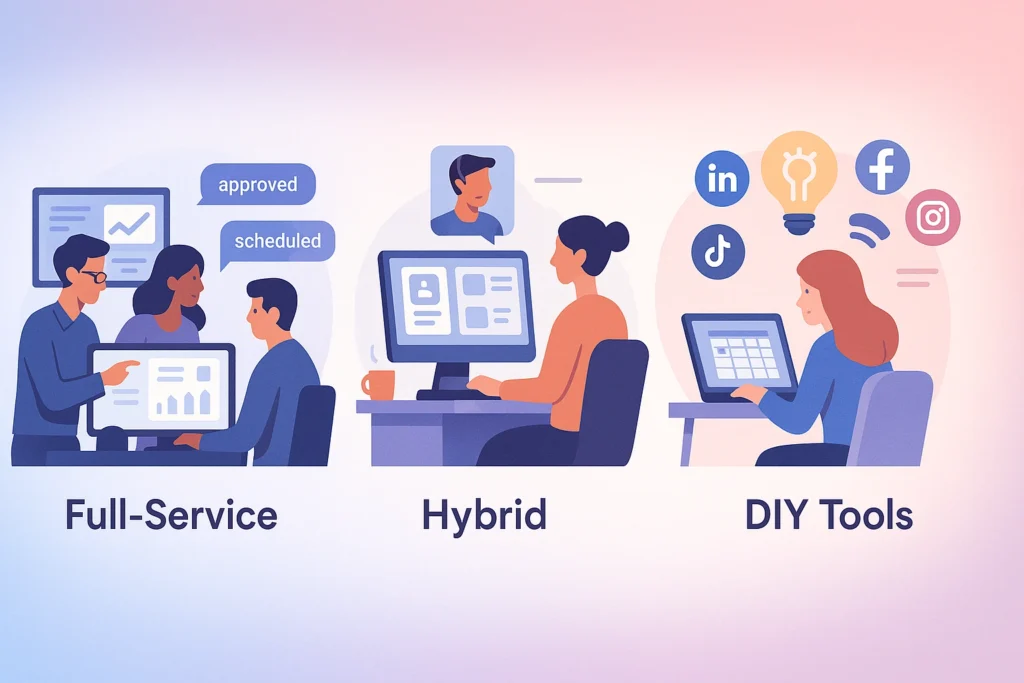
If you strip the buzzwords away, the choice is simple: you either invest your own time, your team’s salary, or a specialist’s fee. Social media management services are just one way to trade money for time and expertise.
Here’s how the main options compare.
1. DIY (you or a team member does it all)
This works when you’re tiny, testing ideas, or only active on one platform. The “cost” is hidden: your time and context switching. Most owners underestimate this part. Hours spent drafting posts and replying to DMs are hours not spent on sales, product, or operations.
2. Tools-only (Buffer, Hootsuite, etc.)
You pay for scheduling and analytics, but you still create the strategy and content yourself. Many modern tools sit in the ~$30–$100/month range for small teams, with advanced suites (Sprout Social, Statusbrew, etc.) costing far more for enterprise features.
3. In-house social media manager
A full-time hire means deeper brand knowledge and instant access, but it’s a bigger fixed cost. Recent salary data puts social media managers roughly in the $55,000–$60,000/year range in many markets, with higher figures in major cities and for senior roles. And that’s before benefits and tools.
4. External social media management services (freelancer or agency)
Here you pay a monthly retainer instead of a salary. In 2025, most businesses fall somewhere between $500 and $5,000+ per month, depending on platforms, posting frequency, and scope, with many “full-service” packages clustering in the $2,000–$5,000/month band.
And if your business sells to other businesses, it’s worth understanding how management changes in a B2B environment — our guide to B2B social media marketing services breaks that down in more detail.
What a Month of Social Media Management Services Actually Looks Like
Most social media management services follow a simple rhythm: plan → create → publish → engage → review → adjust. The details change between providers, but the monthly flow is surprisingly similar.
Here’s what a typical month looks like in practice.
Week 1: Strategy check-in & planning
At the start of the month, there’s usually a quick review of what happened last month: what worked, what flopped, and what’s coming up (promos, launches, events). From there, the team outlines themes, key messages, and any campaigns that need support. Think of this as setting the “storyline” for the month.
Week 1–2: Content creation & approvals
Next, posts are created based on that plan. That can include captions, graphics, carousels, short-form video scripts, or stories. You’ll normally see everything in a content calendar or shared doc. Your job here is to approve, tweak, or say “nope, not this.”
Week 2–4: Scheduling, publishing & community management
Once approved, content is scheduled in a social media tool, so it goes out at the right times without anyone manually posting every day. Meanwhile, the social media manager keeps an eye on comments, mentions, and DMs, replying where appropriate and flagging anything important for you.
End of month: Reporting & optimization
At the end of the month, you get a report: what reached the most people, what drove the most engagement or clicks, and any trends worth noting. Those insights feed back into the next month’s plan, so you’re not just repeating the same thing and hoping for better results.
That’s the real value of a managed process: it’s not random. It’s a loop that gets a little smarter every month.
How to Choose Social Media Management Services You Can Trust
The safest way to choose a social media management partner is to judge them by their process, transparency, and proof of results — not just their price or follower counts. That’s the real filter.
Here’s how to break it down.
- Start with their discovery process
Good partners ask a lot of questions: about your audience, goals, brand voice, offers, and internal capacity. If a provider is ready to sell you a package after a five-minute chat, that’s a red flag. Reputable agencies typically run some level of audit or onboarding questionnaire before proposing anything. - Ask to see relevant examples
Case studies, anonymized reports, or example content for businesses similar to yours matter more than flashy big-brand logos. You’re looking for evidence they can grow awareness, engagement, or leads for your type of business, not just anyone. - Check how they define success
If they only talk about posting frequency and follower growth, be careful. Strong partners connect their work to business goals: website visits, enquiries, sales, or at least qualified leads and meaningful engagement. - Clarify scope, communication, and ownership
You should know exactly what’s included: number of platforms, posts, revisions, response times for comments/DMs, meeting cadence, and reporting. Also confirm who owns the content and ad accounts (it should be you). - Watch for overpromises
Anyone guaranteeing specific follower numbers, viral posts, or exact revenue is gambling with your expectations. Real pros talk in scenarios, ranges, and timelines, not magic.
If a partner scores well on these points and you feel you can communicate openly with them, you’re probably in safe territory.
Social Media Management Services Packages: Realistic Benchmarks for 2025
Let’s start with the part most people really want to know: “What does a normal package actually look like?”
There’s no universal standard, but by 2025 most agencies and freelancers group services into tiered packages. The labels change, the structure doesn’t.
Here’s a simple, realistic benchmark you can compare against:
1. Starter / Essential Package
- 1–2 platforms (often Instagram + Facebook, or LinkedIn for B2B)
- ~8–12 posts per month
- Basic content creation (graphics + captions)
- Scheduling and light community management (comments only)
- Simple monthly report
This tier suits small businesses testing the waters or keeping a consistent presence without going all-in.
2. Growth Package
- 2–3 platforms
- ~12–20 posts per month
- Mix of static posts, carousels, and some short-form video
- Community management (comments + basic DMs)
- Monthly strategy call + deeper reporting
This is where many growing brands land: they want momentum, not just maintenance.
3. Scale / Premium Package
- 3–5 platforms, sometimes including TikTok, YouTube Shorts, or Pinterest
- Higher posting cadence + story content
- Strong focus on video, campaigns, and experimentation
- Proactive community management and basic social listening
- Advanced reporting, possibly including lead or revenue tracking
Pricing will vary a lot by region and scope, but these tiers give you a ballpark of what’s “normal” to expect in terms of deliverables. If you want a more detailed breakdown of how these kinds of packages map to budgets, you can dig deeper in our guide on social media growth packages and pricing.
FAQs About Social Media Management Services
They’re worth it if you have clear goals and not enough time or expertise to execute them yourself. Most businesses now see social media as a core channel, not a side project, and 90% of small businesses use social as part of their marketing strategy.
You’ll usually see early signs (more reach, comments, or clicks) within the first month or two, especially if you’re starting from zero. Most providers and agencies point to 3–6 months of consistent activity before you see stronger, compounding growth in followers, leads, or sales.
Is daily posting mandatory for growth?
Not for most businesses. What matters more in 2025 is consistent, relevant content and strong engagement than a rigid “post every day or fail” rule.
You can grow organically, especially with good content and active engagement, and many consumers still discover brands via organic recommendations and comments. Paid ads, though, help you speed things up and reach new audiences more predictably.
AI is changing the job, but most recent analyses say it’s more of a sidekick than a full replacement. AI is getting good at things like drafting ideas, repurposing content, and analyzing data, but strategy, brand voice decisions, and nuanced community interactions still rely heavily on humans.