What Is Influencer Marketing Engagement Rate (and Why It’s the Ultimate Quality Filter)?
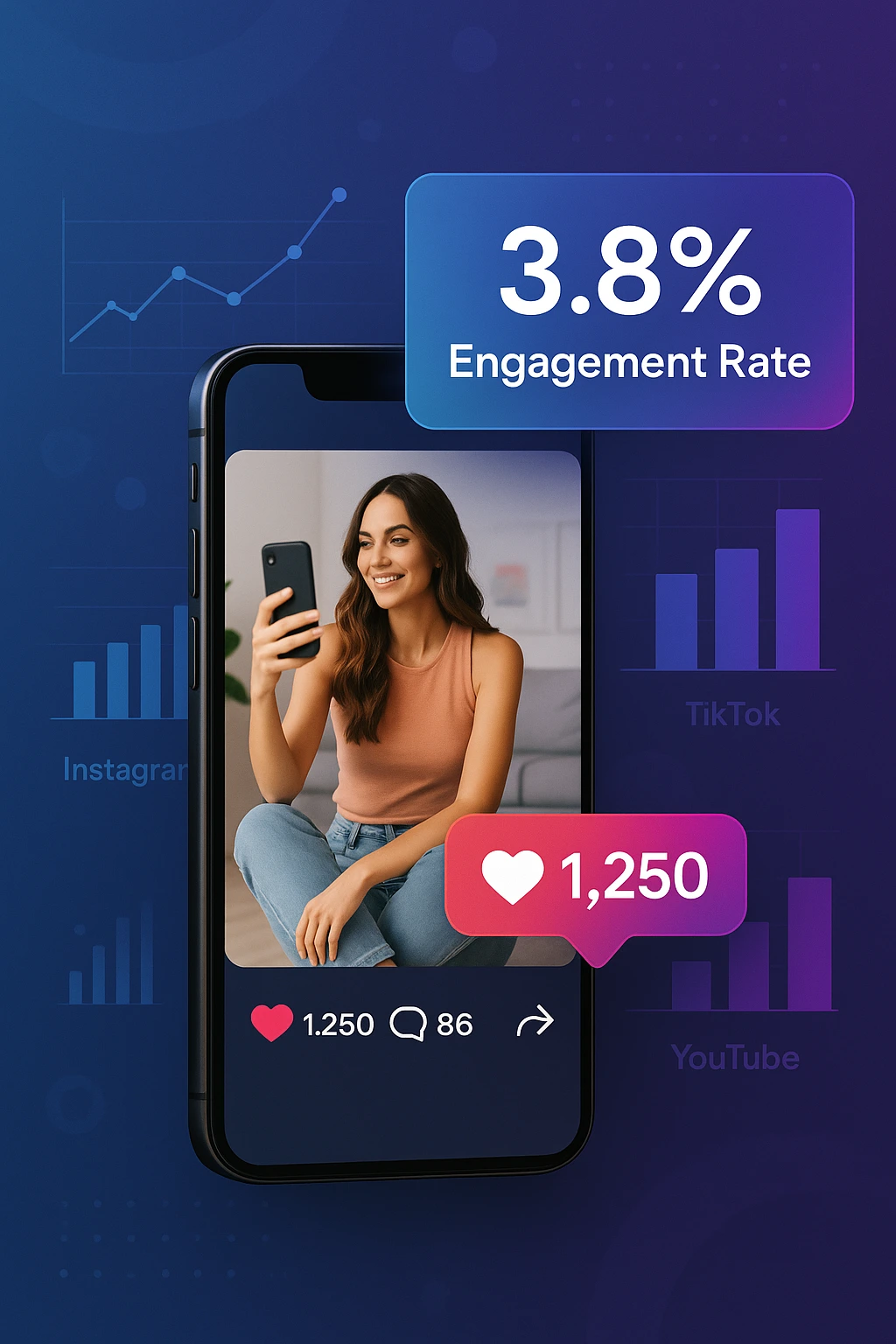
Influencer marketing engagement rate is simply the percentage of people who actually do something with an influencer’s content – like, comment, share, save, click – instead of just scrolling past it. It’s the quickest way to separate “looks big” from “actually works” in influencer campaigns.
In practice, you’re comparing interactions vs audience size over a set of posts. If an influencer gets 2,000 total interactions on content that reached 50,000 people, you’re looking at a 4% engagement rate. The exact formula changes slightly depending on whether you divide by followers, reach, or impressions (we’ll break those down in the next section), but the core idea stays the same:
Out of everyone who saw this, how many cared enough to react?
Why is this the “good vs bad” filter? Because, in 2025, most brands already know follower count can be wildly misleading. Industry data still shows that smaller creators tend to drive proportionally more engagement than bigger ones, with micro and nano influencers often beating macro creators by a noticeable margin. When your goal is trust, clicks, or conversions, that difference matters more than a flashy profile header.
So when we talk about what a good influencer marketing engagement rate looks like, we’re really asking:
“Is this creator’s audience actively responding at a level that justifies our spend, for this platform and this tier?”
How to Calculate Influencer Marketing Engagement Rate Correctly (Formulas That Brands Use in 2025)
If you want the cleanest way to calculate influencer engagement rate, use this core idea (Source: hootsuite)
Engagement Rate = (Total Engagements ÷ Base Metric) × 100.
“Total engagements” usually means all the visible interactions on a post or set of posts: likes, comments, shares, saves, maybe clicks depending on the platform. The part that trips people up is the base metric. That’s where you can quietly distort reality without meaning to.
Here are the three main versions you’ll see in 2025:
- By followers (most common for influencers)
ER (followers) = (Total engagements ÷ Followers) × 100
This is what most engagement calculators and influencer tools still default to. - By reach
ER (reach) = (Total engagements ÷ Reach) × 100
Better when you’re judging a specific campaign and you actually know how many people saw the content. - By impressions or views
ER (impressions) = (Total engagements ÷ Impressions/Views) × 100
Platforms like X (Twitter) and TikTok lean heavily on impression- and view-based calculations in their analytics.
So which should you use?
- If you’re shortlisting influencers, use by followers to compare creators on a level playing field.
- If you’re evaluating a campaign, use by reach or views because that reflects what actually happened with delivered eyeballs.
- And if numbers look “too good to be true,” check whether they quietly changed the base metric.
What Is a Good Influencer Marketing Engagement Rate in 2025? (Benchmarks by Platform & Tier)
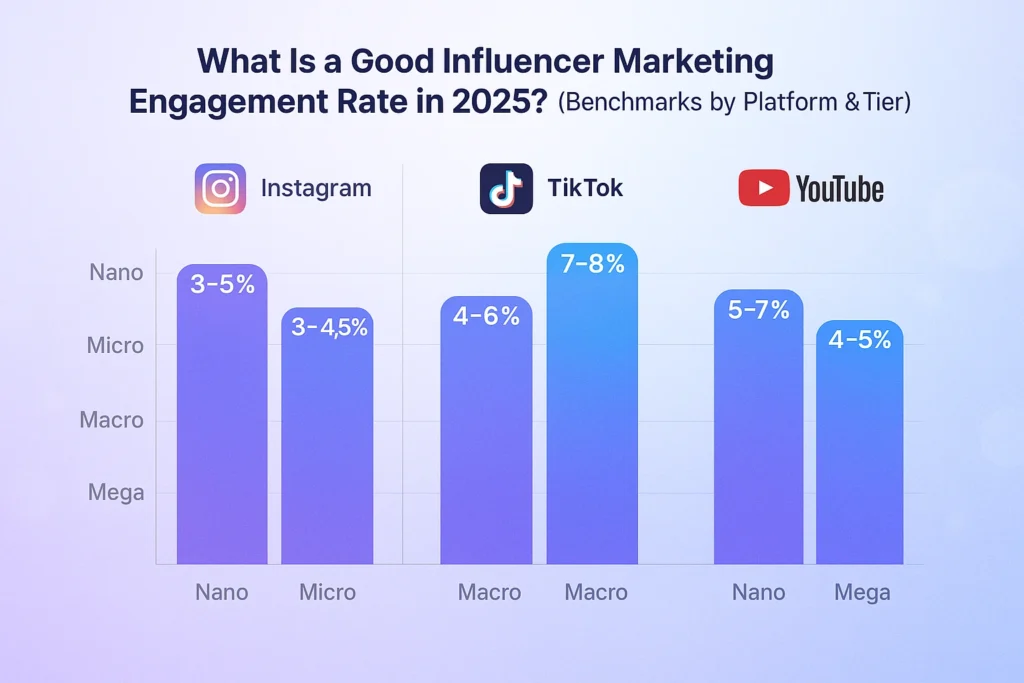
In 2025, a “good” influencer engagement rate is usually in the 3–6% range, with smaller creators trending higher and big celebrity-style accounts typically lower.
Across recent 2024–2025 studies, one pattern is extremely consistent:
nano and micro influencers have the highest engagement, and it drops as follower count increases.
A few data points to ground this:
- A 2025 influencer stats report notes that micro influencers on Instagram average around 3.86% engagement, while mega influencers sit closer to 1.21%.
- A HypeAuditor analysis (cited mid-2025) found nano creators at ~2.53% average engagement vs. mega at ~0.92%, across platforms.
- Platform-wide social benchmarks (all accounts, not just influencers) for Q4 2024 put Instagram and TikTok around 2% average engagement, meaning top influencers performing well are usually comfortably above that.
- For YouTube creators, 2025 influencer data shows nano / micro channels around 5–5.5% ER, and macro / mega closer to 3–4% or even 2–3% at the very top end.
So instead of chasing a single “magic” number, think in bands by platform and tier.
2025 Influencer Engagement Rate Benchmarks (Cheat Sheet)
These ranges blend several 2024–2025 benchmark sources and round them into realistic, usable bands for influencer selection, not lab-perfect numbers.
| Platform | Influencer Tier | Typical Average ER (posts) | What “Good” Usually Looks Like* |
|---|---|---|---|
| Nano (1k–10k) | ~2–3% | 3–5%+ is strong, 6%+ is excellent | |
| Micro (10k–100k) | ~2–3.5% | 3–4.5%+ is solid for this tier | |
| Macro (100k–1M) | ~1–2% | 2–3%+ is above average | |
| Mega (1M+) | ~1–1.5% | 1.5–2.5%+ is generally “good” | |
| TikTok | Mixed tiers (by views) | ~3–4% ER by views overall | 4–6%+ is strong, 7–8%+ very strong |
| YouTube | Nano / Micro | ~4.5–5.5% | 5–7%+ is a healthy target |
| YouTube | Macro / Mega | ~2.5–4% | 4–5%+ is strong for larger channels |
| All platforms | Nano vs Mega (overall) | Nano ~2.5% vs Mega ~0.9% | “Good” is clearly higher than these baselines for the same niche and platform |
Before you lock in your influencer list, make sure your engagement, reach, and conversion targets are aligned with a clear growth framework. If you’re still shaping your KPIs, our full social media growth strategy guide breaks down how to build goals that actually move your brand forward.
Influencer Marketing Engagement Rate vs Follower Count: Which One Predicts Better Results?
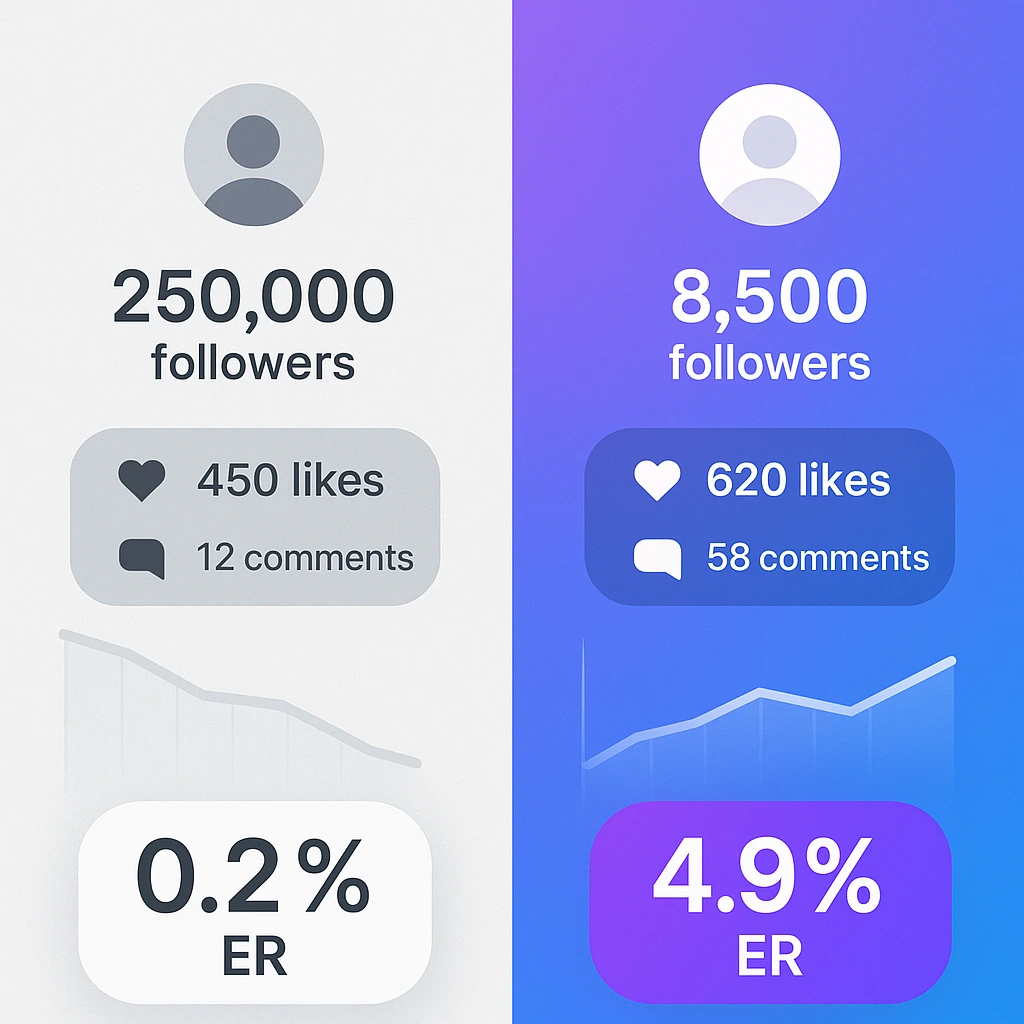
If you have to choose, engagement rate beats follower count almost every time when it comes to predicting real results from influencer marketing.
Follower count only tells you how many people could see the content in theory. It doesn’t tell you how many care enough to react, click, or buy. In 2024–2025 reports, you see the same pattern repeated:
as follower count goes up, average engagement rate goes down, especially from micro to mega influencers. That means a lot of big accounts look impressive but behave like billboards—seen, not acted on.
Engagement rate, on the other hand, is tied much more closely to audience trust and responsiveness. Studies on nano and micro influencers show they often drive higher engagement and better cost-per-engagement than larger creators, even though their reach is smaller. Brands keep shifting budget toward smaller tiers for exactly this reason.
But does that mean follower count is useless? Not really.
Here’s the better way to think about it:
- Follower count = potential scale
- Engagement rate = likelihood of action
For performance-driven campaigns (sign-ups, sales, app installs), you want solid engagement rate first, then enough follower count to make the math work. A 5% ER on 10k followers can easily outperform a 1% ER on 200k followers in cost and results, once you factor in fees.
Factors That Influence Influencer Marketing Engagement Rate (And What Brands Can Control)
If you strip away the hype, engagement rate mostly comes down to four things:
the audience, the content format, the creator’s relationship with that audience, and how clearly they invite people to react.
Some of that you can’t touch. Some of it you absolutely can.
Let’s break it down.
1. Audience quality (the invisible foundation)
A “good” engagement rate starts with a real, relevant audience. Studies up to 2025 keep showing that fake followers, broad untargeted audiences, or locations that don’t match your market drag engagement down and waste spend. Tools like HypeAuditor, Modash, and similar platforms routinely flag this as the number one issue when brands run audits.
What you can influence:
- Choose influencers whose top countries and age groups match your target.
- Avoid creators who’ve grown mainly via giveaways or follow-for-follow—these are notorious engagement killers over time.
2. Content format and platform trends
Engagement rate is heavily shaped by format. On most platforms in 2024–2025, short-form video formats (Reels, TikToks, Shorts) and vertical video with a strong hook outperform static images for likes, comments, and shares. Carousels on Instagram also tend to drive above-average engagement compared to single-image posts, because they encourage swipes and time-on-post.
What you can influence:
- In your brief, push for formats the platform is boosting (Reels, TikToks, Shorts, carousels), not just “one feed post.”
- Ask creators what formats historically get their highest engagement and build the campaign around those, not your internal favorite.
3. Relationship and trust with the audience
Influencers with a tight, conversational relationship—especially nano and micro creators—almost always show higher engagement. Their followers feel like they “know” them. That’s why nano and micro tiers keep winning on average ER in recent benchmarks.
What you can influence (indirectly):
- Prioritize creators who reply to comments, show up in Stories, and share bits of real life.
- Look at their comments: are people writing full sentences, telling stories, asking questions? That’s usually a sign of trust, not just reach.
4. Hooks, storytelling, and clear CTAs
Honestly, this part trips most brands up. They brief influencers with “Please promote our product” and then wonder why engagement is flat.
Strong engagement usually comes from:
- A clear hook in the first 1–3 seconds or first line.
- Content that feels like their usual style, not a stiff ad.
- A specific call to action (“Comment X”, “Save this for later”, “Tell me your experience”, “Which would you choose?”).
What you can influence:
- Include example hooks and prompts in your brief, but let creators rewrite in their own voice.
- Tie engagement goals to concrete CTAs, not just “raise awareness.”
So, what really drives influencer engagement rate?
You can’t change who already follows a creator, but you can choose better-aligned creators, push for the right formats, and brief in a way that makes engagement almost inevitable instead of accidental.
How to Use Engagement Rate in Influencer Marketing to Choose the Right Creators
If you’re choosing influencers in 2025, start with this rule:
Engagement rate is your first filter, not follower count.
Brands are finally behaving this way in the real world. Recent 2025 reports show nano and micro influencers still generate meaningfully higher engagement than bigger creators, often 40–60% more interactions than macro and mega tiers. That’s why more brands are shifting budget toward smaller creators and long-tail collabs, not just celebrity names.
Here’s a simple way to turn engagement rate into a selection framework instead of a random “nice-to-have” metric:
1. Set minimum ER guardrails by tier
Use rough floors so you don’t waste time on low performers:
- Nano (1k–10k): avoid under 1.5–2%
- Micro (10k–100k): avoid under 1–1.5% (Instagram averages hover around ~1–2% depending on the report)
- Macro/Mega (100k+): be skeptical below 0.8–1%, unless they’re dirt cheap or offer huge non-engagement value (PR, brand lift, etc.)
These aren’t magic numbers; they’re stop signs. If someone consistently sits under them, you need a very good reason to proceed.
2. Score creators, don’t just “feel” your way
For each influencer, rate them 1–5 on:
- Engagement rate vs tier (are they above, at, or below typical?)
- Audience fit (country, age, interests match your buyer)
- Content quality + brand fit (style, tone, values)
- Cost (fee vs expected reach and engagement)
Even a quick spreadsheet where you add these up forces you to choose the people who are good on paper and in practice, not just the ones your team happens to follow.
3. Use ER differently by goal
- For conversion or lead-gen campaigns, weight engagement rate very heavily.
- For awareness or PR, you can accept slightly lower ER from bigger names, but don’t ignore it altogether—2025 data still links active communities with stronger campaign impact.
That’s how you stop “influencer selection” from being a vibe-based debate and turn it into a repeatable, data-backed system.
Red Flags: When a High Influencer Marketing Engagement Rate Is Too Good to Be True
Here’s the uncomfortable truth: in 2025, a high engagement rate isn’t always good news. A chunk of it can be fake. Recent analyses citing HypeAuditor’s data suggest that up to 55% of influencer engagement on Instagram can be inauthentic, driven by bots and engagement pods, and brands are on track to lose over $2B to influencer fraud in 2025.
So what should you watch for?
1. Numbers that don’t match reality
- Very high ER with weak comments: 10–20% engagement but mostly emojis, “nice pic,” and repetitive phrases is a classic pod/bot pattern.
- Identical engagement across posts: every post sitting at ~2,000 likes and 150 comments, regardless of topic or time, is suspicious.
2. Odd follower and growth patterns
- Spiky follower growth (sharp jumps, then flat) often hints at bought followers or loops/giveaways.
- Strange follower quality: many accounts with no profile pictures, no bios, or random usernames are a red flag.
3. Comment quality vs quantity
Authentic engagement looks a bit messy: varied lengths, questions, references to specifics in the post.
If more than ~30% of comments are spammy or generic, some 2025 fraud analyses suggest you might be looking at 40–60% fake followers.
4. Not using any vetting tools
Given how common fraud is (1 in 4 influencers has bought fake followers, according to recent stats), most serious brands now run authenticity checks with tools like HypeAuditor, Grin, Qoruz, Hypefy, SocialBook, etc.
If an influencer’s engagement looks amazing but fails the comment, growth, and tool checks, treat that “good” engagement rate as a red flag, not a green light.
How to Improve Influencer Marketing Engagement Rates in Your Campaigns
Most recent influencer reports point to the same levers behind high-performing campaigns: short-form video, creator freedom, and clear calls to action. Brands that lean into Reels/TikToks/Shorts and co-created concepts see stronger engagement than those treating creators like ad slots.
And if you prefer handing off the analytics side, our social media management service can monitor engagement trends and optimize creator selection on your behalf. Now, here is what to focus in your campaigns:
1. Co-create the concept, don’t dictate the ad
Campaigns perform better when creators keep their own voice and format, instead of reading a script. 2024–2025 surveys show that audiences reward authenticity and punish obviously scripted, brand-heavy content with lower engagement.
- Share your goal, key messages, and must-have points, then ask:
“How would you naturally talk about this?” - Approve concepts, not line-by-line scripts.
2. Use engagement-friendly formats the platform is boosting
Short-form vertical video is still king: Instagram Reels, TikTok videos, YouTube Shorts. Benchmarks consistently show these formats driving higher ER than static images on their respective platforms.
Practical moves:
- Prioritize Reels/TikToks/Shorts + Stories over only feed images.
- For Instagram, add carousels for save-worthy, educational content.
3. Build engagement into the brief (not as an afterthought)
Honestly, this is where a lot of campaigns die. The post goes live and… there’s nothing for people to do.
Add explicit engagement prompts:
- “Comment your experience with…”
- “Which would you choose, A or B?”
- “Save this for later” for tips and checklists.
Campaigns that use clear, simple CTAs consistently show higher comment and save rates in platform case studies and brand reports.
4. Iterate with creators who actually perform
Use your engagement data to double down on the right people:
- Track ER per creator across multiple posts.
- Renew and scale spend with those who reliably beat your benchmarks.
- Gently phase out the ones who stay flat, no matter how “on brand” they look.
That’s how engagement rate becomes not just a metric you admire, but a lever you actively pull to improve every campaign.
Quick FAQs About Influencer Marketing Engagement Rate (What People Always Get Wrong)
Here’s a wrap-up of the questions people keep asking on Reddit, forums, and in 2024–2025 reports — plus straight answers from Socialmedia Tutor:
Is a 0.2% engagement rate good or terrible?
Why has my (or my creator’s) engagement dropped so much in 2024–2025?
Do giveaways and contests ‘count’ toward engagement rate, or are they cheating?
Key references used here:
HypeAuditor – State of Influencer Marketing 2024 & 2025 insights
Creatortag / Eleve – fraud and fake engagement stats (55% fake ER, $2B loss)
Influencer Marketing Hub, Influencer Hero, Inflead – fake follower and engagement red flags
Qoruz, Hypefy, SocialBook, Grin – vetting and fraud-detection tool guidance