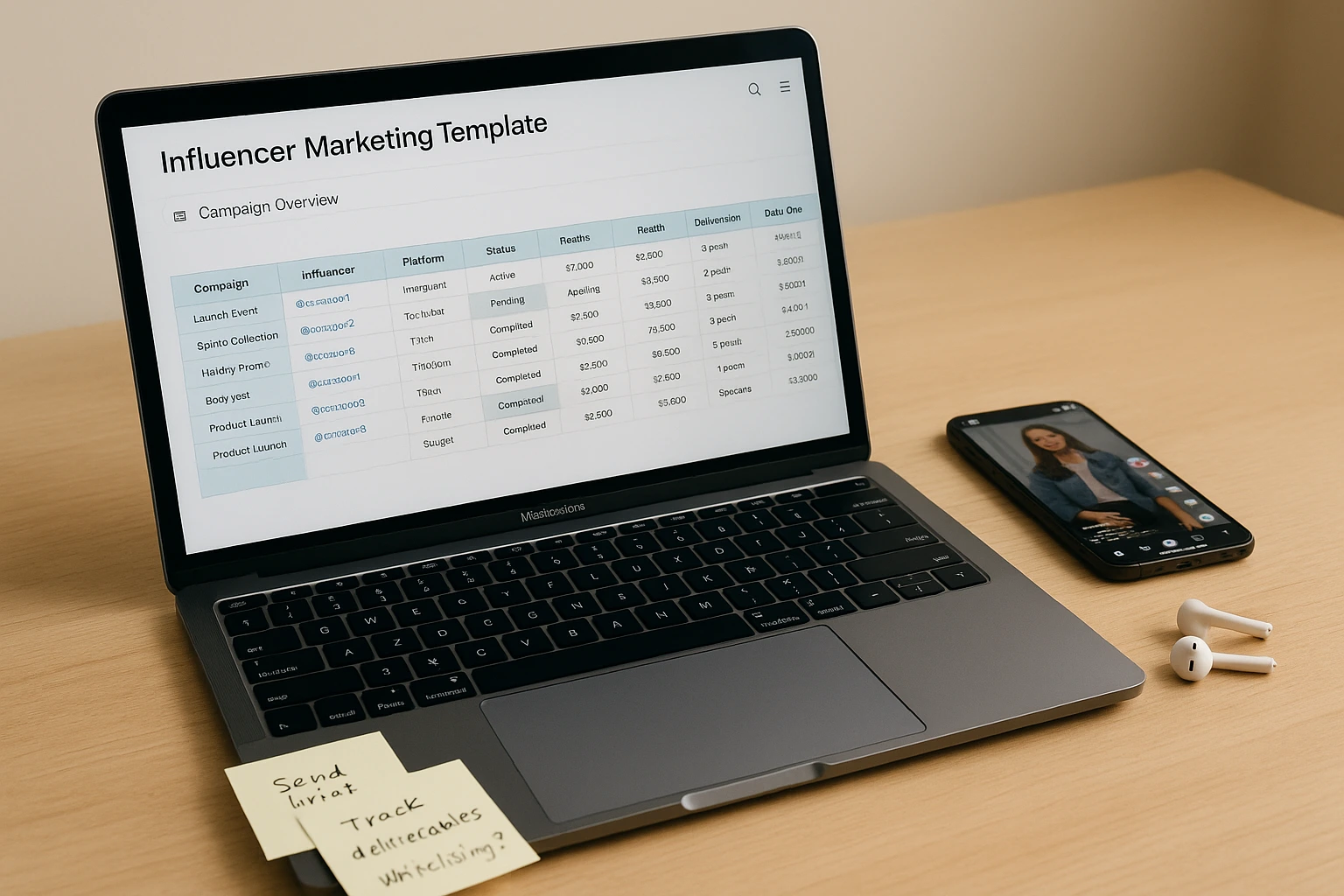
A simple 5-sheet system gives you one job: run influencer campaigns without dropping balls. No more half-finished briefs in Drive, DMs you can’t find, and “Wait, did anyone track that post?” moments.
Before You Download Any Influencer Marketing Template: How This 5-Sheet System Actually Works
Influencer marketing isn’t experimental anymore. In 2025, more than 80% of marketers say they use influencer campaigns, and most plan to increase budgets because the channel keeps delivering strong ROI — often around $5–6 back for every $1 spent when it’s done well. That kind of money flowing into creators means chaos if you’re not organized.
And if you’re small? You don’t need a 40-tab monster. For a solo marketer or first campaign, this same system can live in a single file with five tabs. You can always add complexity later; the real win is having the same structure from day one.
Zooming out, the global influencer marketing industry itself is now worth around $20–24 billion in 2025, depending on the source, and is forecast to grow at roughly 25–30%+ CAGR into the early 2030s. So the stakes are only going up: more spend, more creators, more pressure to justify results.
Influencer Marketing Template Sheet 1 – Strategy & Campaign Planning Framework
Your first sheet should force every campaign to start with goals, not influencers.
Recent data shows that around 60–70% of marketers now run influencer campaigns with explicit performance goals (sales, leads, or traffic), not just “awareness.” On top of that, multiple 2024–2025 reports note that brands who define clear objectives and KPIs upfront are significantly more likely to report “strong ROI” from influencer activity compared to those using vague goals like “brand buzz.” (Exact uplift varies by study but typically sits in the +20–30 percentage point range in terms of satisfaction/ROI reporting.)
So Sheet 1 should capture, at minimum, these fields per campaign:
- Campaign name + objective type (awareness, traffic, sales, UGC, app installs).
- Primary KPIs (impressions, reach, clicks, conversion rate, revenue, UGC volume).
- Target audience basics (market, segment, key pain points).
- Channels (TikTok, Instagram, YouTube, etc.) and core format (short-form, long-form, stories, live).
- Offer & CTA (discount, launch, waitlist, trial, content download).
- Dates (planning start, launch, wrap).
- Budget (cash fees, product value, production costs, tools).
Practically, that means columns like:
Campaign | Objective | KPI 1 | KPI 2 | Audience | Main Platform | Offer | Launch Date | End Date | Budget (Cash) | Budget (Product) | Owner | Status
This planning sheet becomes the single source of truth you reference in all other tabs: database, briefs, outreach, and performance. If a campaign line in this sheet doesn’t have a clear objective, KPIs, budget, and dates, it’s not ready for influencers yet. To fill out the performance section of this template, make sure you understand how to calculate influencer engagement rate accurately.
Influencer Marketing Template Sheet 2 – Influencer Database & Vetting System
This sheet exists for one reason: don’t pay the wrong people.
Influencer fraud is still a big, very real problem. Recent 2024–2025 data shows around 59–60% of brands report encountering influencer fraud, and roughly two-thirds of marketers say they’re worried about it. One major report also notes that one in four influencers has bought fake followers, and close to 10% of Instagram accounts are bots. No surprise that AI-powered fraud detection and “audience integrity” checks are now flagged as one of the big trends in influencer marketing for 2025.
So your Influencer Database & Vetting sheet needs to go beyond “name + follower count.” At minimum, every row (one per creator) should capture:
- Handle, platform, country, language
- Follower count + tier (nano, micro, macro — micro and nano still deliver the strongest engagement in most benchmarks)
- Niche / category (beauty, fitness, SaaS, etc.)
- Average engagement rate (posts or videos) vs typical ranges of ~1–5% for authentic accounts, depending on platform and industry
- Audience top countries + age bands
- Brand safety flags (controversial content, off-brand topics)
- Fraud / quality signal (suspicious spikes, botty comments, very low or strangely high ER)
- Past collaborations + performance notes
Example column header block you can paste straight into a sheet:
Handle | Platform | Country | Tier | Followers | Avg ER % | Top Countries | Main Niche | Fraud Risk (Low/Med/High) | Notes | Shortlisted For Campaign
This turns vetting into a repeatable scoring exercise instead of gut feel. When fraud is costing brands an estimated $1B+ a year globally, having this structured view isn’t a “nice to have” — it’s literally protecting your budget.
Influencer Marketing Template Sheet 3 – Campaign Brief & Content Requirements
Your brief sheet should cut revision rounds and prevent creators from walking away.
Creator-side data backs this up. A Bazaarvoice survey found 62% of influencers have turned down brand partnerships, and 35% did so because the brief was unclear or not a good fit. On the workflow side, multiple 2025 collaboration guides recommend capping revisions at 1–2 rounds, and call it a red flag when campaigns regularly need 3+ rounds, because it usually means the brief itself was vague or incomplete.
So Sheet 3 should standardize exactly what every campaign brief includes. At minimum, track these fields per campaign or per creator:
- Brand & product context (short description, key value props).
- Objective reference (link or ID back to Sheet 1 row).
- Target audience summary (who the content is for).
- Deliverables (format, number of posts, length, orientations).
- Mandatory elements (key messages, offers, hashtags, tags, disclosure text).
- Hard “no” list (topics, phrases, visuals to avoid).
- Approval flow (who signs off, expected review time, max revision rounds).
- Usage rights & timeline (where and how long you can reuse the content).
In a spreadsheet, that might look like:
Campaign ID | Creator Handle | Deliverable Type | # of Assets | Key Message | Must-Include Tags/Hashtags | No-Go Topics | Approval Owner | Max Revisions | Usage Rights (months) | Status
This turns the “brief” into structured data. It lets you quickly see which campaigns lack key details, where approvals are stuck, and whether you’re constantly breaking that 1–2 revision guideline that most 2025 best-practice workflows now recommend.
Influencer Marketing Template Sheet 4 – Outreach & Collaboration Pipeline
This sheet’s job is simple: turn influencer outreach into a measurable pipeline, not a messy inbox.
In 2024–2025 data, brands and creators are both pushing for more structured, long-term collaboration. One report found 63.2% of brands now prefer sustained influencer partnerships over one-off deals, up from 57% in 2022. On the creator side, another survey shows 49% of creators say long-term campaigns are their favorite way to work with brands, and **93% are open to working for product compensation if they genuinely like the brand. So your pipeline needs to track not just “did they reply?” but “are we building a relationship worth keeping?”
Outreach performance is also very trackable now. Influencer outreach tools and CRM-style platforms recommend monitoring open rates, click rates, bounces, spam reports, and unsubscribes per outreach wave, just like you would for email marketing. Case studies show reply rates above 30–40% are achievable when messages are personalized and targeted, not mass-blasted. And timing matters: Collabstr data suggests collaborations are more likely to go through when influencers respond within about 14 hours of your proposal.
To bring this into your Sheet 4, use clear stages similar to a sales pipeline: Identified → Shortlisted → Contacted → In Negotiation → Contract Signed → Content Live → Closed / Not Moving.
Example columns:
Creator Handle | Platform | Campaign | Stage | Last Contact Date | Reply Y/N | Proposed Rate | Agreed Rate | Compensation Type (Cash/Product/Mix) | Next Step | Long-Term Potential (Y/N)
This turns outreach into something you can optimize: you can actually see where conversations stall, which messages convert best, and which creators are worth nurturing for those long-term deals that 2025 data says both sides increasingly want.
Influencer Marketing Template Sheet 5 – Performance, Budget & ROI Dashboard
This is the sheet that tells you whether influencer marketing deserves more budget or not.
Across recent 2025 reports, brands earn around $5.78–$6.50 in revenue for every $1 spent on influencer marketing on average, with top campaigns hitting up to 20:1. Some studies even frame this as **up to 11× the ROI of traditional digital ads. That’s why more than 60% of brands say they plan to increase influencer budgets, and a growing share fold influencer spend into core digital budgets instead of treating it as an experiment.
But those numbers only matter if you can see your own ROI. So Sheet 5 should track, at minimum, per campaign and per creator:
- Core performance metrics – reach, impressions, engagement rate, clicks, conversions.
- Attribution data – UTM links, discount codes, affiliate links, landing pages.
- Revenue outcomes – sales value, average order value, subscription value.
- Cost lines – fees, product value, shipping, platform/tools, agency fees.
That lets you calculate simple but powerful ratios:
Cost per Click (CPC) | Cost per Acquisition (CPA) | ROAS | ROI %
Example column block:
Campaign | Creator | Reach | Clicks | Conversions | Revenue | Total Cost | CPA | ROAS | Notes
Once this is in place, you can stop arguing from “influencer is trendy” and start arguing from hard numbers: which creators, formats, and platforms actually outperform your paid social benchmarks.
How to Adapt Your Influencer Marketing Template for Different Brands and Channels
You don’t need new templates for every brand type. You just tweak the 5 sheets based on whether you’re B2C, B2B, or running ambassadors vs one-offs.
For B2C and ecommerce, your sheet tweaks should follow the platforms where consumers actually engage. 2025 stats show TikTok posts averaging around 18% engagement in the U.S., compared with roughly 2.4% on Instagram and 0.5% on YouTube, with smaller creators on TikTok still beating Instagram on engagement (≈7.5% vs 3.65%). At the same time, Instagram remains the top choice for about 57% of brands, while TikTok is used by ~52% despite some investment volatility.
So for B2C:
- Planning sheet → add fields for short-form video focus, social commerce objectives (product tags, live shopping).
- Performance sheet → track add-to-cart, checkout starts, and social commerce revenue per platform, not just clicks.
For B2B and SaaS, the mix shifts. Recent data shows around 81–85% of B2B companies now budget specifically for influencer programs, and over half plan to increase that budget. B2B buyers say they value case studies (47%), webinars (39%), reports (35%) and expert reviews/video (32%) as influencer content. Short-form video still matters: **41% of B2B marketers say short-form is the highest-ROI video format.
So for B2B:
- Planning sheet → include content formats like webinars, LinkedIn Lives, whitepapers.
- Performance sheet → add lead quality, opportunities created, and pipeline value, not just revenue.
Finally, if you run ambassador / always-on programs, label them clearly. One 2025 B2B report found **99% of teams using an always-on influencer approach rated their programs effective. Brand ambassador guidance also stresses long-term loyalty vs one-off visibility.
- Planning sheet → flag “always-on/ambassador” vs “one-off launch.”
- Outreach sheet → add contract length and renewal date.
- Performance sheet → track long-term metrics like repeat purchases or renewal rate per creator.