If you’re an enterprise marketer, you already know social isn’t “nice to have” anymore. It’s where your buyers research, compare, and quietly judge you long before a demo request lands in Salesforce. Around 90% of B2B marketers use social as a primary content distribution channel, and LinkedIn remains the top platform for reaching decision-makers.
But here’s the tension: most “B2B social media marketing services” still sell you impressions, followers, and content volume. Meanwhile your CFO wants pipeline, deal influence, and a clear story on ROI. In 2024–25, paid social became one of the top ROI drivers in B2B, yet many enterprise teams still treat it like an awareness-only playground.
This article is written for enterprise buyers—CMOs, VPs, and heads of digital—who are evaluating partners, or quietly wondering if they picked the wrong one. We’ll unpack how services should be structured, how real buying committees make decisions (often 6–13 stakeholders now), what to demand from a partner, and the mistakes that lead to those painful “we burned 12 months on this agency” conversations.
Think of this as a buyer’s manual, not an agency brochure.
FACTs:
1. One Platform Quietly Owns B2B Social — and It’s Not Even Close
LinkedIn is responsible for around 80% of all B2B leads generated via social media, and nearly 50% of social traffic to B2B websites comes from LinkedIn alone.
2. By the Time Buyers Talk to Sales, Social Has Already Sold (or Killed) You
Modern B2B buyers are 70–80% of the way through their journey before they ever speak to sales, and they’ll usually consume 11–13 pieces of content along the way.
3. Social Is Quietly the Hero Channel… and Still Weirdly Underfunded
In recent surveys, social media is cited as the single biggest contributor to B2B marketing program success by nearly half of marketers — beating out many other tactics.
Yet about a third of B2B marketers still say they allocate a low budget to social, even as over half of buyers get product information via social channels.
What B2B Social Media Marketing Services Really Mean for Enterprise Brands
At the enterprise level, B2B social media marketing services aren’t just “posting on LinkedIn” — they’re a revenue-supporting system that shapes perception, demand, and deal flow across a long buying cycle.
For most B2B brands, social now sits across the entire funnel: early-stage education, mid-funnel validation, late-stage reassurance for buying committees who are checking whether you’re credible, current, and trusted in your space. Over 4 in 5 LinkedIn members influence business decisions, which means your social presence is effectively a live, public proof-of-competence that your best prospects see daily.
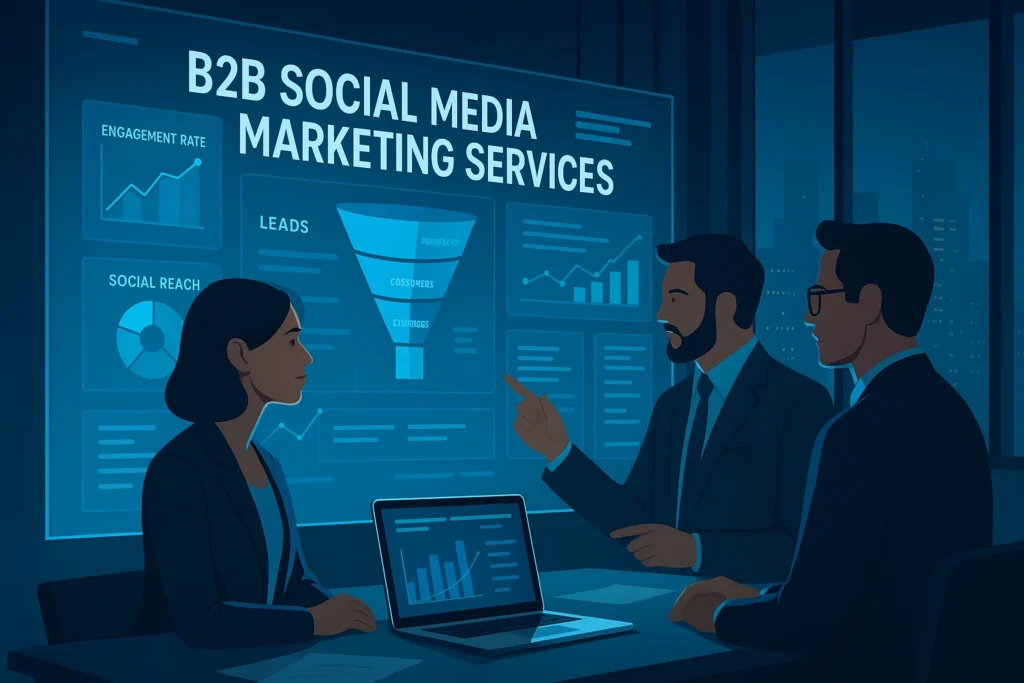
In practice, “services” should cover far more than content production. For an enterprise, they typically include:
- Market and audience insight to understand complex buying groups
- Strategic positioning and messaging that ties directly to your GTM
- Channel strategy, usually with LinkedIn as the spine and other platforms supporting specific use cases
- Executive and sales-team enablement (social selling, leadership brands)
- Measurement frameworks that connect social activity to website behavior, opportunities, and revenue
The real differentiator? How tightly these services plug into your broader revenue engine—CRM, marketing automation, ABM, and sales motions. If a provider can’t talk comfortably about opportunity stages, buying committees, and multi-touch attribution, they’re probably selling “posts,” not a strategic B2B social program.
The Enterprise Social Media Problem: Why Generic B2B Social Media Services Don’t Work Anymore
For large B2B brands, the core problem isn’t “we’re not posting enough.” It’s that generic social media programs aren’t built for long, messy, committee-based buying—so they quietly fail the moment deals get complex.
Over the last few years, B2B buying has exploded in complexity. Recent data shows buying groups now typically involve 6–10 people, and for big or global deals that can stretch into double digits. Each of those stakeholders has different success metrics, different levels of risk tolerance, and their own backlog of content they’ve already consumed about you. On top of that, enterprise teams are juggling more regions, more channels, and more internal politics than ever.
Most “full-service” or generic agencies simply weren’t designed for that world. They:
- Repurpose light, generic content across every platform with minor tweaks, instead of building channel- and role-specific narratives for different stakeholders.
- Treat social like a linear funnel or broadcast channel, even though B2B journeys are non-linear, self-directed, and heavily digital.
- Optimize for vanity metrics—reach, impressions, followers—while your leadership team is asking, “Which accounts, segments, and opportunities did this actually move?”
You see the gap most clearly in reporting. Many enterprises still get monthly decks that talk about engagement rate and “top-performing posts,” but don’t trace that activity into CRM stages, opportunity creation, or influence on active deals. Meanwhile, surveys show B2B buyers increasingly prefer rep-free, digital-first research and actively avoid vendors that hit them with irrelevant outreach.
In other words: a generic social feed can look busy while doing almost nothing for real pipeline. Enterprise brands need partners who can navigate internal complexity, plug into RevOps, and build social programs that are judged on revenue outcomes—not just content volume.
Core Components of Modern B2B Social Media Marketing Services
At enterprise level, a “B2B social media package” should map to how your buyers actually research, compare, and choose—not just how often you post. Here’s what that looks like when it’s done properly.
1. Strategy & Positioning (Not Just a Content Calendar)
You start with ICPs, buying committees, and real deals. A solid partner will translate your GTM, offers, and competitive landscape into clear narratives for different roles (CFO vs VP Ops vs end user), then back that into social goals tied to pipeline, not just awareness. Recent B2B benchmarks show social is most effective when it reinforces a distinct POV, not just product updates. A strong partner begins by aligning your GTM, ICPs, and narrative into a unified social media growth strategy, ensuring everything from thought leadership to campaigns ladders up to revenue-driven messaging.
2. Channel & Campaign Architecture With LinkedIn at the Spine
In 2025, LinkedIn is still the dominant B2B platform: ~80% of B2B social leads come from it, and the vast majority of B2B marketers use it as their primary distribution channel. A modern service mix usually puts LinkedIn at the center, then layers YouTube, X, and sometimes TikTok/Instagram for awareness, events, and employer brand. Each channel has a defined job in the buyer journey.
3. Content Engine: Thought Leadership + Demand Gen
Winning programs mix:
- POV-led leadership content (problem framing, mental models, hot takes)
- Demand-gen assets (webinars, reports, product stories)
- Sales enablement content mapped to real objections
Short-form video is surging on LinkedIn and other platforms, but text-based posts and carousels still perform strongly for education and thought leadership.
4. Paid Social, Retargeting & ABM Plays
Modern services assume paid + organic from day one: targeted LinkedIn campaigns, retargeting of high-intent visitors, and ABM-style plays against named accounts. This is where you see impact on opportunity creation and deal velocity.
5. Community, Exec Profiles & Social Listening
You’re not just talking at the market anymore. Mature providers run executive profiles, employee advocacy, and social listening to track sentiment, competitor moves, and “dark social” conversations (what’s being discussed off-platform).
6. Analytics & RevOps Integration
Finally, the backbone: UTM discipline, CRM and marketing automation integration, and dashboards that connect social to MQLs, opportunities, and influenced revenue. If a provider can’t show this, you’re buying activity, not outcomes.
How Enterprise Buyers Evaluate B2B Social Media Marketing Services
Enterprise brands don’t choose a social media partner on vibes and a pretty deck. They choose based on risk, revenue impact, and whether the agency can survive a buying committee of 6–15 people all pulling in different directions.
Here’s what really happens behind the scenes. First, marketing defines the problem: “We need social to drive pipeline, not just impressions.” Then they pull in sales, RevOps, regional leads, sometimes IT and legal. Recent reports show average buying groups are now 10–11 stakeholders, and for multinational deals it’s often 15+. Every one of them checks something different: credibility, security, integration, cultural fit, cost.
When they look at agencies, three evaluation lenses usually show up:
- Strategic fit. Does this partner understand our industry, ACV, and sales motion? Enterprise teams heavily favor agencies with proven results in similar sectors and visible thought leadership, not just generic “B2B experience.”
- Operational fit. Can they handle our pace, regions, approvals, and exec expectations? Buyers check processes, SLAs, who’s actually on the account, and whether the agency can collaborate with internal teams instead of fighting them.
- Technical & proof fit. Do they plug into our CRM/automation stack and report on pipeline, not just engagement? Teams scrutinize case studies, attribution stories, and whether the agency can show social influencing opportunities in real data, not anecdotes.
And here’s the part agencies underestimate: most of this evaluation happens digitally before a single call. Most buyers compare vendors quietly long before the discovery call—often browsing lists of the best social media marketing companies to see which ones demonstrate real enterprise expertise versus generic B2C-heavy portfolios.
Service Models & Pricing for B2B Social Media Marketing Services (Agency vs In-House vs Hybrid)
For most enterprise brands, the best setup is usually hybrid—a strategic agency + a lean internal team—because it balances expertise, cost, and flexibility. But it helps to see the numbers clearly.
1. Agency Retainers: What You Actually Pay
Recent 2024–2025 pricing guides show:
- Basic social management: often $500–$5,000/month for lighter programs.
- Full-service social across 3–5 platforms: typically $2,000–$5,000/month.
- Enterprise-level programs with strategy, content, paid, and reporting: can reach $10,000–$20,000+/month, especially when you add paid media management and advanced reporting.
That usually includes strategy, content production, publishing, community management, and monthly/quarterly reporting.
2. In-House: The Real Cost
In 2024–2025, average social media manager salaries in the US sit roughly between the mid-$50Ks and mid-$70Ks per year, depending on seniority and market. In Europe, typical social media marketer salaries fall around €30K–€50K+, again depending on country and level.
Now layer on:
- Benefits, tax, equipment, training
- Additional headcount for design, video, paid media, analytics
- Tooling (social management, listening, creative, reporting)
By the time you have a genuinely enterprise-capable in-house team, you’re often well into six figures annually—and you still may lack deep platform expertise or up-to-the-minute best practices.
3. Why Hybrid Wins So Often
A hybrid model usually looks like:
- In-house: strategic owner + internal stakeholders (brand, product, sales)
- Agency: heavy lifting on strategy, creative, always-on execution, and advanced analytics
You keep internal control of direction and context, while the agency brings specialist skills at a lower marginal cost than hiring a full in-house studio. For most enterprises, that’s the sweet spot between scalability, risk management, and speed to impact.
Must-Have Deliverables From Any B2B Social Media Marketing Service Provider
If an agency can’t clearly show you these deliverables, you’re not looking at an enterprise-ready partner. You should be able to see, touch, and review all of this every month or quarter.
1. Strategic Social Playbook & Content Calendar
You’re not buying ad-hoc posts. You’re buying a documented strategy (ICP, messaging, content pillars) and a forward-looking content calendar that maps what goes live, where, and why. Modern B2B guides treat the calendar as a living roadmap that aligns campaigns, avoids last-minute chaos, and ties posts back to business goals.
2. Clear KPIs & Reporting That Go Beyond Vanity Metrics
Every reporting cycle should come with agreed KPIs: site behavior, leads, opportunity influence—not just likes and follower counts. 2025 commentary on B2B metrics is brutally clear: over-focusing on vanity metrics hides what actually drives pipeline.
3. Campaign & Asset Packages
For each major push (product launch, event, ABM play), expect packaged assets: post copy variations, creatives, short-form video, UTM-tagged links, and landing page recommendations. Think “campaign kit,” not random one-offs.
4. Governance, Policy & SLAs
At enterprise level, social without governance is a risk. A serious partner will help shape or follow your social media governance: approval workflows, escalation paths, archiving, and compliance guidelines—especially critical in regulated industries. You should also see SLAs covering response times, reporting cadence, and scope boundaries.
5. Executive & Employee Advocacy Enablement
Modern B2B programs increasingly include playbooks for leaders and employees—post templates, do/don’t lists, and light training—so personal profiles amplify the brand in a controlled way.
Many enterprise teams assume a social media management service stops at scheduling and reporting, but enterprise-ready providers also bring governance, escalation workflows, and multi-region content operations your in-house team often can’t support alone.
Common Mistakes Enterprises Make When Buying B2B Social Media Marketing Services
Even sophisticated teams fall into the same traps when they shop for “B2B social media marketing services.” A lot of regrets you hear a year later (“we wasted that retainer”) trace back to these.
1. Choosing on Price and Volume, Not Fit and Revenue
This is the big one. Enterprise teams get dazzled by “30 posts per month across 5 channels for X/month” and forget to ask: What business outcome is this designed to move?
Industry surveys over the last few years keep repeating the same pattern: marketers feel pressure to prove ROI, but many still optimize social for volume and low cost instead of strategic impact. That’s how you end up with busy feeds, low-quality leads, and nothing meaningful to show in the CRM later.
If the main differentiator between vendors is who’s cheaper and posts more, you’re already in the wrong shortlist.
2. Treating Social as a Standalone Tactic
Another common mistake: buying social services as if they’re independent of your GTM, paid media, content, or sales motions. In reality, your buyers move fluidly across channels—social, search, website, email, peer communities—and most of their research happens long before they talk to sales.
When social isn’t integrated with campaigns, events, product launches, and sales enablement, it becomes an isolated “activity channel.” It might look fine in a silo report, but it won’t consistently show up in opportunity creation, deal velocity, or win rates.
3. Ignoring the RevOps and Data Conversation
Many enterprise teams sign an agency before fully exploring how social data will tie into their stack: CRM, marketing automation, attribution, dashboards. Then three months later everyone is frustrated because nobody can answer, “Which accounts engaged?” or “Did this campaign touch any open opportunities?”
If you don’t involve RevOps, data, or at least a technically minded marketer in the buying process, you risk ending up with pretty reports that never make it into the systems your execs actually watch.
4. Underestimating Internal Complexity and Approval Bottlenecks
On paper, the scope looks simple. In reality, you’re dealing with:
- Multiple regions and languages
- Product and legal reviews
- Brand, comms, and PR all having a say
Many enterprises underestimate how much internal friction slows execution, and assume an agency can magically “move fast” without alignment. The regret later is: “The agency was fine, but we never cleared enough approvals to see real momentum.”
If you don’t talk frankly about workflows, approvers, and capacity upfront, the best strategy in the world will stall.
5. Over-Relying on a Single Champion
A lot of social programs hinge on one internal hero—usually a head of digital or social lead—who understands the vision. When that person leaves or changes role, the program falls apart because the agency relationship and strategy weren’t properly socialized with sales, product, and leadership.
For an enterprise, that’s a structural risk. You want a partner who insists on broader stakeholder alignment, regular cross-functional reviews, and documentation that survives personnel changes.
6. Not Setting Clear “Go/No-Go” Milestones
Finally, many brands sign 12-month retainers without defining what success should look like at 90, 180, and 365 days. So when renewal time comes, everyone has strong feelings but weak evidence.
Setting explicit milestones—audits and foundation in Q1, leading indicators (traffic, engagement from target accounts) by midyear, and clearer pipeline influence as tracking matures—gives you a fair way to decide whether to double down, adapt, or switch. Without that, regret is almost guaranteed.
FAQs: The Real Questions Enterprise Buyers Ask About B2B Social Media Marketing Services
Here are the “quiet” questions people ask on Reddit, forums, Quora, and in Slack channels—plus straight, short answers, provided to you by Socialmedia Tutor:
Yes, it can drive pipeline—but only if it’s tied to campaigns, offers, and your CRM. Studies in 2024–2025 show social (especially LinkedIn) is one of the highest-ROI channels when used for both top- and bottom-funnel plays, not just impressions.
Is LinkedIn too saturated now to still work?
It’s crowded, but not “dead.” B2B buyers are still most active and most open to business content there—84% of B2B marketers rate LinkedIn as their top ROI channel, and short-form content is performing especially well in 2025. The bar is just higher for quality and POV.
No. Most 2025 strategy guides advise focusing on a few high-impact platforms (usually LinkedIn + 1–2 others) where your audience is genuinely active, instead of spreading thin across everything. Depth beats presence.
Rough rule of thumb: 3 months to get foundations and leading indicators (reach, engagement, traffic from the right accounts), and 6–12 months for clearer opportunity and revenue impact—assuming tracking is set up properly. Pipelines with long sales cycles simply take longer to reflect the work.
Depends on scope. A single in-house hire is cheaper month-to-month but often can’t cover strategy, creative, paid, video, analytics, and governance at an enterprise level.