Social media is one of those things almost every business is “doing,” but very few are doing intentionally. You’ve got someone posting, maybe dabbling in Reels, replying to the odd DM… and yet the needle barely moves. No real spike in leads. No noticeable lift in sales.
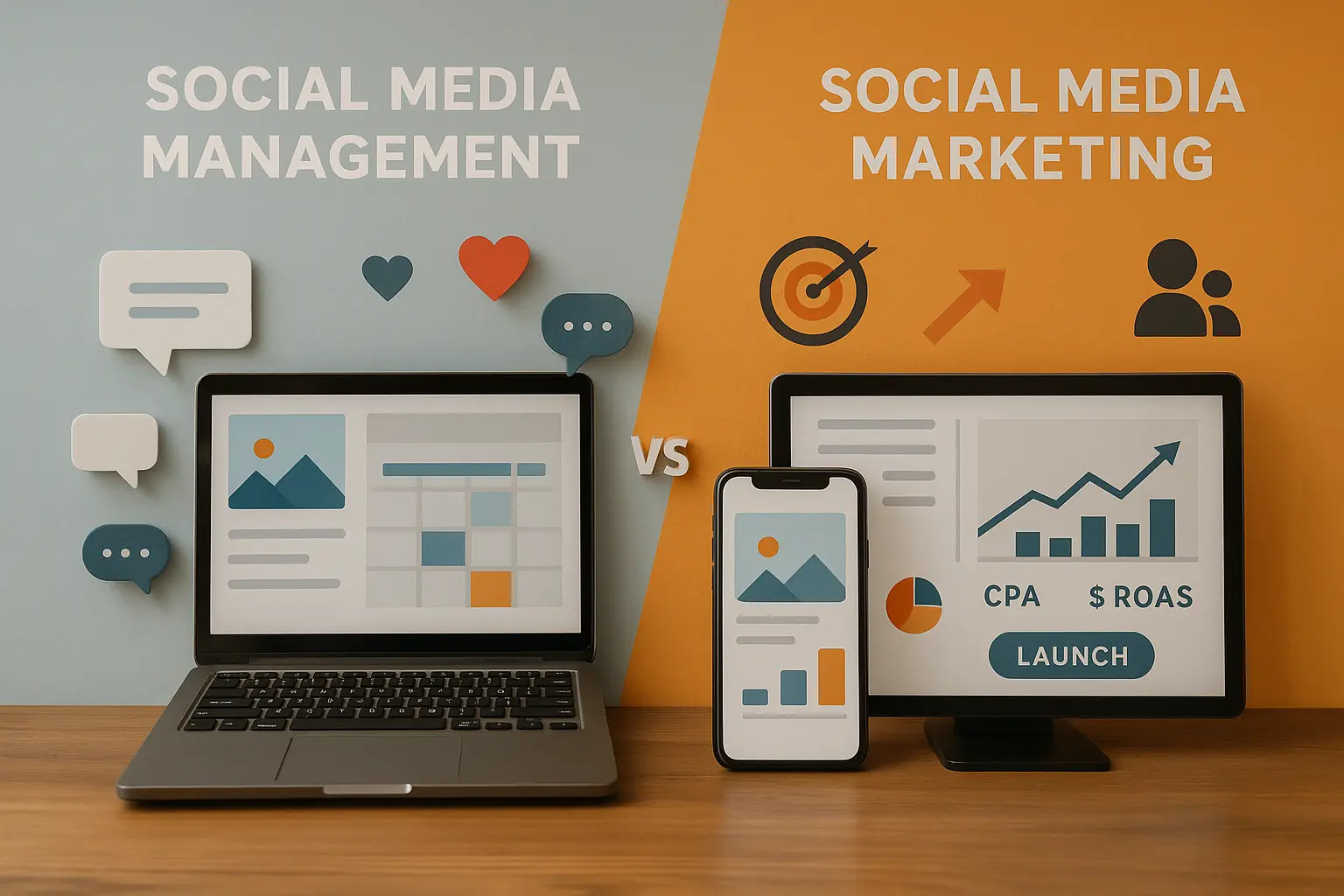
Social Media Management vs Social Media Marketing: 60-Second Quick Answer
Social media management keeps your brand active and responsive every day, while social media marketing is what actually drives growth, leads, and sales.
You can think of it like this: management runs the store; marketing brings people to the store.
In 2025, most experts describe social media management as the ongoing work of planning, creating, scheduling, and responding on your channels so your brand stays visible and trustworthy. That includes things like building a content calendar, posting regularly, replying to comments and DMs, and monitoring performance.
By contrast, social media marketing uses those same platforms more aggressively to hit specific business goals: website traffic, leads, sign-ups, or direct sales. It leans on campaigns, offers, funnels, and often paid ads to move people from “I’ve seen this brand around” to “I’m ready to buy.”
What Is Social Media Management? Definition, Tasks, and Real Examples
Social media management is the ongoing, day-to-day work of running your brand’s presence on social platforms—planning, creating, scheduling, and responding so you stay visible and relevant. It’s less about “big campaigns” and more about making sure your brand shows up well, every single day.
In practice, that means building a content calendar, writing captions, creating images or short-form videos, scheduling posts, and keeping an eye on comments, DMs, and mentions. Most 2025 guides also include social listening, basic analytics, and reputation management in the definition, because brands are judged publicly and instantly now. If something blows up—good or bad—your social media manager is usually the first to see it.
On a typical day, a social media manager will:
- Check overnight notifications and respond to comments or messages
- Review today’s scheduled posts and make tweaks if news or trends shifted
- Engage with followers and creators (liking, commenting, resharing)
- Pull quick performance snapshots and note what’s working (or flopping)
In 2025, the job has stretched a bit. Managers are expected to understand short-form video, community building, and how to stand out in feeds flooded with AI-generated content. They’re also using more tools—schedulers, inbox managers, and analytics dashboards—to juggle multiple platforms without losing their minds.
What Is Social Media Marketing? Strategy, Campaigns, and Sales
Social media marketing is using social platforms deliberately to drive business results—not just likes or views, but clicks, leads, sign-ups, and sales. It takes the visibility your social media management creates and turns it into measurable growth.
Instead of asking, “What should we post today?”, social media marketing starts with questions like:
- What offer are we promoting this month?
- Who exactly are we targeting?
- What action do we want them to take?
From there, it builds campaigns: structured sequences of posts, emails, landing pages, and often paid ads designed to move people through a funnel—from awareness, to interest, to action. In 2025, this usually involves a mix of organic content, retargeting ads (showing content to people who’ve already interacted with you), and direct-response creatives optimized for conversions on platforms like Meta, TikTok, LinkedIn, or YouTube.
Typical social media marketing tasks include:
- Researching audiences, competitors, and angles that actually resonate
- Crafting campaign concepts, hooks, and offers (discounts, lead magnets, webinars, launches)
- Creating and testing multiple ad creatives and formats (Reels, Stories, carousels, UGC-style videos)
- Setting up targeting, budgets, and tracking (pixels, UTM tags, custom audiences)
- Monitoring results and optimizing based on cost per click, cost per lead, ROAS, and overall revenue
7 Key Differences Between Social Media Management and Social Media Marketing
If you zoom out, the core split is simple: social media management keeps your presence running smoothly, while social media marketing is built to drive growth and revenue. Everything else hangs off that.
Main Goal:
First, the main goal is different. Management is about showing up consistently, staying on-brand, and maintaining healthy relationships with your audience. It’s judged on whether your channels feel active, human, and responsive. Marketing, on the other hand, is judged on hard outcomes: did this activity actually increase awareness, generate leads, or bring in sales?
Type of work
The type of work reflects that. Social media management is operational and routine. It’s content calendars, drafting posts, scheduling, replying to comments, answering DMs, and monitoring mentions. Social media marketing is more strategic and campaign-based. It focuses on shaping offers, planning funnels, setting up paid or organic campaigns, and deciding why you’re posting in the first place.
Time horizon
They also run on slightly different time horizons. Management is always-on, like customer service. You don’t “turn it off” without looking abandoned. Marketing tends to move in sprints: launches, promotions, seasonal pushes, or experiments with clear start and end dates, followed by review and optimization.
Key metrics
When you look at metrics, the contrast gets even clearer. Management leans on engagement rate, follower growth, response time, and community sentiment. Those numbers tell you if people are interacting with you and how they feel. Marketing zooms in on performance data tied to money: click-through rates, cost per lead, cost per acquisition, return on ad spend, and total revenue attributed to social.
Skills needed
The skills are not identical either, even if one person sometimes wears both hats. A strong social media manager is usually great at writing, visual storytelling, organizing content, and handling conversations—even tricky ones—in the comments. A social media marketer needs to be comfortable with strategy, testing, analytics dashboards, and ad platforms, and with making decisions based on data, not vibes.
Business role
Their role in the business also sits in different places. Management supports your brand and community. It makes sure customers feel heard and prospective buyers see a living, breathing business. Marketing plugs directly into sales and growth. It’s expected to move people along the customer journey—from “never heard of you” to “ready to buy” or “ready to book a call.”
How leadership sees them
Finally, there’s how leadership perceives them. Social media management often gets grouped mentally with PR and comms: important, but sometimes seen as “soft.” Social media marketing is treated more like performance marketing: budgets are approved or cut based on visible ROI. That’s why marketers are challenged more aggressively on their numbers, while managers are judged more on brand health and consistency.
How Social Media Management and Social Media Marketing Work Together in Practice
They’re not rivals. Social media management and social media marketing work best as a loop: management builds trust and attention, marketing turns that attention into results, then the data from marketing improves what you manage day to day. Brands that combine both see stronger long-term performance than those treating them as either/or.
Start with management. A perfect social media growth strategy includes consistent posting schedule, active replies, and a recognizable voice create what’s basically your “always-on” storefront. That’s how you stay visible to a slice of the 5+ billion social media users worldwide, and why people don’t feel weird clicking when they finally see an offer from you.
Once you’ve got a warm, engaged audience, you can layer campaigns on top: launches, promotions, lead magnets, retargeting ads. Those efforts turn followers into leads and customers, using clearer calls to action, landing pages, and paid targeting. Agencies and 2024–2025 guides are pretty blunt about this:
The magic happens when the two feed each other:
- Campaigns reveal which messages, offers, and creatives convert best.
- Management uses that insight to shape everyday content and conversations.
- Ongoing engagement makes future campaigns cheaper and more effective because your audience already trusts you.
So if you imagine your social presence as a flywheel: management keeps it spinning; marketing gives it those powerful pushes that move revenue. Ignore either one for long, and the whole system slows down.
Social Media Manager vs Social Media Marketer: Who Should You Hire First?
Start With Your Real Bottleneck
Forget job titles for a second. Your first hire should match your biggest problem:
- “We don’t show up consistently.”
- “We’re visible, but it’s not turning into leads or sales.”
Those are two different issues, and they point to two different roles.
When a Social Media Manager Should Be Your First Hire
If your feeds are messy, half-abandoned, or handled “when someone has time,” your real gap is execution and consistency. That’s professional social media management services.
A manager builds your content calendar, posts regularly, keeps an eye on comments and DMs, and makes sure you don’t look dead when someone checks you out online. For small businesses and solo founders, just having one person clearly owning this can be a huge upgrade from the classic “everyone kind of posts sometimes” situation.
When a Social Media Marketer Should Come First
If you’re already posting often, getting some engagement, maybe even growing followers, but you can’t link social to revenue, your problem is strategy, not output. That’s where a social media marketer (often called a paid social or performance marketer) comes in.
Their job is to design campaigns, set up tracking, run or coordinate ads, and connect social to landing pages, email, or your CRM so you can actually see leads and sales attributed to social.
When an Agency Makes More Sense
An agency usually makes sense when you need both management and marketing, plus access to specialists you can’t hire one by one—strategists, content creators, media buyers, analysts. Agencies cost more than a single hire, but they bring a ready-made team and established processes, which is why many brands use them once social becomes a serious growth channel.
The “Do-It-All” Myth
One person can absolutely blend management and light marketing at the beginning. But expecting a single junior hire to act like a full agency—posting, designing, editing video, running ads, doing deep analytics—is exactly the pattern professionals complain about in 2024–2025.
Social Media Management vs Social Media Marketing Services: Skills, Tools, and Costs
Skills: Who Does What Best?
A strong social media manager is built for consistency and community. In 2025 job specs, you’ll see things like content calendar planning, copywriting, basic design or video editing, social customer service, multi-platform posting, and community management listed as core skills. They’re also expected to understand how algorithms work, spot trends, and keep your brand voice consistent across channels.
A social media marketer leans more into strategy and numbers. Current guides and job descriptions emphasize campaign planning, offer creation, funnel thinking, data analysis, and paid social skills (Meta, TikTok, LinkedIn, YouTube). They’re judged on outcomes like leads, ROAS, and cost per acquisition, not just “how good the feed looks.”
Tools: What They Actually Use All Day
Managers live inside social media management platforms plus design tools. Pricing guides for 2025 put schedulers and all-in-one tools anywhere from free tiers up to $500+ per month, with most businesses landing in the $30–$1,000 range depending on users and features. Think: planning calendars, inbox management, basic reporting.
Marketers use those too, but add ads managers and analytics: Meta Ads Manager, TikTok Ads, LinkedIn Campaign Manager, Google Analytics, plus testing and listening tools to optimize campaigns across almost five billion social users.
Costs: Rough Ranges in 2025
Across recent pricing studies and agency guides, social media management services for smaller businesses typically fall around $500–$2,500 per month, with more comprehensive, multi-platform or higher-touch packages often running $2,500–$5,000+ per month.
Professional social media marketing / advertising management usually starts in a similar band—roughly $450–$6,000 per month for strategy and management—plus ad spend, which for small businesses often sits somewhere between $500 and $5,000 per month depending on goals and industry. Check out our guide on social media pricing and service packages for more information.
Social Media Management vs Social Media Marketing: Side-by-Side Comparison Table
Here’s the quick, summarized view:
| Aspect | Social Media Management | Social Media Marketing |
|---|---|---|
| Core role | Runs and maintains your day-to-day social presence | Uses social channels to drive growth, leads, and sales |
| Main goal | Consistency, community, brand trust | Awareness, conversions, revenue, pipeline |
| Focus of work | Content calendars, posting, replies, monitoring, social care | Campaigns, offers, funnels, paid ads, testing |
| Time horizon | Always-on, ongoing | Campaign-based with defined pushes and review cycles |
| Typical KPIs | Engagement rate, follower growth, response time, sentiment | Clicks, cost per lead, ROAS, sign-ups, sales |
| Key skills | Writing, visual content, community management, organization | Strategy, analytics, ad platforms, conversion-focused copy |
| Main tools | Schedulers, community tools, basic analytics | Ad managers, analytics suites, tracking + the same schedulers |
| Where it sits in business | Brand, comms, customer experience | Growth, performance marketing, demand generation |
| Best fit for you if… | You look inactive, slow to respond, or inconsistent | You’re active but can’t tie social to measurable business outcomes |
FAQs: Social Media Management vs Social Media Marketing (Real Questions Answered)
For small businesses, yes—one person or a small team often does both. Most professional guides say this is common at early stages, but larger or more ambitious brands usually split the roles because the strategic, data-heavy work and the daily management load are a lot for one person to do well long term.
Nope. Paid ads are one part of social media marketing, not the whole thing. Marketing also includes organic campaigns, content built around offers, funnels, collaborations, and using analytics to optimize everything—not just boosting posts.
Management is mostly organic, but it’s not really “free” once you count time, tools, and creative work. Many 2024–2025 articles describe management as the organic foundation—content, community, listening—sometimes supported by light boosts or promotion when needed.
Which drives revenue faster: management or marketing?
Social media marketing usually drives revenue faster because it focuses on campaigns, offers, and paid or highly targeted activity. But without decent management in place, those campaigns tend to be less effective because people don’t trust or recognize the brand when they land on your profile.
Is follower growth still a meaningful success metric?
It’s useful, but it’s not the main event anymore. Current industry discussions and trend reports put more weight on engagement quality and business outcomes (clicks, leads, sales) than on raw follower numbers, which can be inflated or low-quality.