What Social Media Marketing for Small Business Services Really Looks Like Today
Social media marketing for small business services today is less about “being visible” and more about building a steady pipeline of inquiries, bookings, and repeat clients.
In 2025, most small businesses aren’t asking “Should we be on social?” anymore. Around 90–96% of small and local businesses now use social media as part of their marketing strategy. The question has shifted to: How do we turn all this time online into actual revenue?
Here’s what social media marketing really includes for a service business (think salons, coaches, agencies, clinics, home services):
- A basic strategy: clear goals like “10 more bookings per month” instead of “grow followers.”
- Platform choices based on where your clients already spend time – usually some mix of Facebook, Instagram, YouTube, TikTok, or LinkedIn.
- Content creation that shows proof (results, testimonials), process (how you work), and personality (why you’re different).
- Daily micro-engagement: replying to DMs, comments, reviews, and using social as a customer service touchpoint.
- Optional but powerful: paid promotion on your best-performing posts.
- Light analytics so you know what actually brings in calls, emails, and form fills.
And yes, this matters. In 2025, 58% of consumers say they discover new businesses via social media, and about **78% research a brand on social before buying. If your service business looks inactive, messy, or confusing there? People quietly move on.
So, social media marketing for small business services isn’t just “posting consistently.”
It’s building a simple, repeatable system that moves someone from first scroll to paid client.
Play #1 – Use Social Media Marketing Goals That Drive Revenue for Small Business Services
If you want social media to bring in more clients, you have to start with revenue goals – not “get more followers.”
Pretty much every 2024–2025 social media strategy guide starts the same way: define clear goals that tie back to business outcomes like sales, leads, or bookings. That’s not theory. It’s because without those goals, you can’t decide what to post, where, or how often without guessing.
For a service business, think in very concrete terms:
- “Add 10 more booked appointments per month from social.”
- “Get 20 qualified discovery calls per month from Instagram + Facebook.”
- “Generate 30 new quote requests per month from local homeowners.”
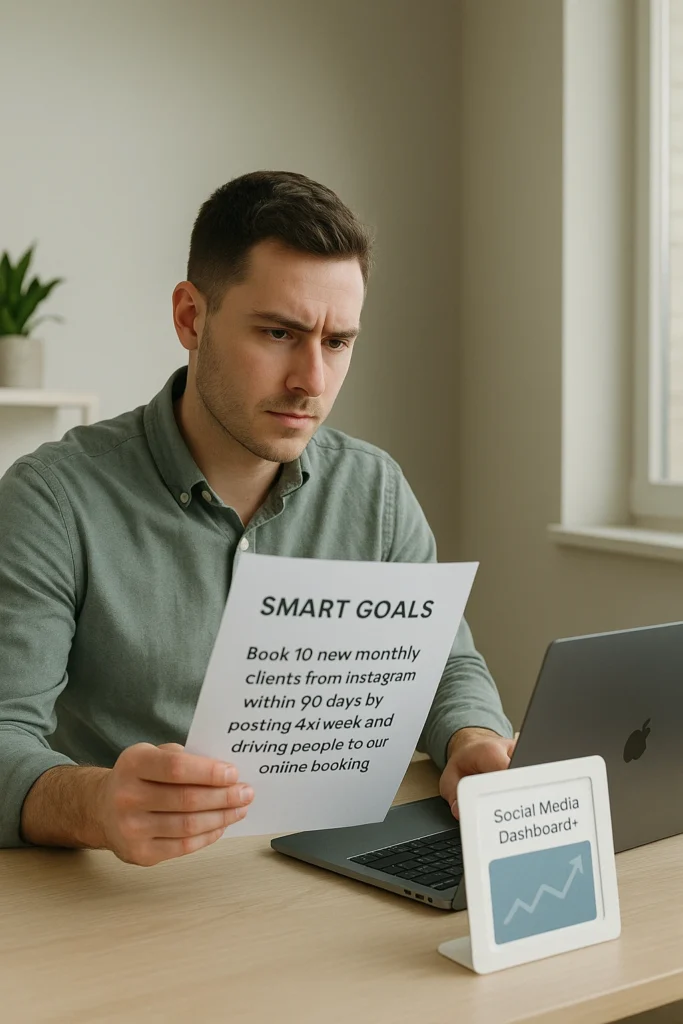
Once that’s clear, you shape your social media goals using the SMART framework (specific, measurable, achievable, relevant, time-bound) – which is still the standard in 2025 for digital and social planning.
A simple example:
“Book 10 new monthly clients from Instagram within 90 days by posting 4x/week and driving people to our online booking page.”
Now your content has a job.
Every post either helps someone discover you, trust you, or take the next step (DM, call, booking link). If it doesn’t, it’s just noise.
Honestly, this is usually the part where people hesitate. It’s easier to say “we’ll just be active” than to commit to a number. But that commitment is what lets you later ask:
- Did social actually help us grow?
- Which platform or content type contributed most to those bookings?
No more random posting. You’re designing your feed around the money.
Play #2 – Choose Social Media Platforms That Your Small Business Service Clients Already Use
If you want more clients, not just more content, you should only be active where your buyers actually hang out – usually 1–2 main platforms. Not five.
In 2025, the big players for small service businesses are still:
- Facebook & Instagram – massive reach, strong local discovery, easy DMs, plus Meta’s built-in tools for appointments and ads.
- TikTok – huge for “how-to,” transformations, and personality-driven brands. Great for coaches, beauty, fitness, and home improvements.
- LinkedIn – best for B2B services, consultants, agencies, and professional services where decision-makers scroll during work hours.
- YouTube / Shorts – ideal if you can commit to video explainers, tutorials, or deep dives that keep pulling in leads over time.
Here’s the simple filter:
- Where are my clients already scrolling daily? (Ask them. Check where they message you.)
- Where have we already seen some traction? (Even small: saves, replies, profile visits.)
- Can we realistically create content in the format that works there? (Short-form video, carousels, stories, etc.)
If you’re a local salon, clinic, contractor, real estate pro, or home service?
You’ll almost always start with Facebook + Instagram, maybe add TikTok once you’re steady.
If you’re B2B or advisory (consultant, agency, coach)? LinkedIn + one “depth” channel (YouTube or a podcast clipped for social) is often enough. Once you’ve narrowed your platforms, you can build them out using a complete social media growth strategy that aligns with your long-term goals.
The goal isn’t to be “everywhere.”
It’s to go deep where it counts, show up consistently, and make it incredibly easy for the right people to find you, trust you, and book.

Play #3 – Build a Simple Client Persona for Effective Social Media Marketing in Small Business Services
If you want social media to send you the right clients, you need a clear, simple picture of who those people are. That’s your “booked-out client” persona.
Step 1: Start With Your Favorite Real Clients
Forget imaginary avatars for a second. Look at the three to five real clients you’d happily clone. The ones who pay on time, appreciate your work, and don’t drain your energy.
Write a few lines about each: what they do, roughly how old they are, where they live, and what made them reach out in the first place. Note how they first found you too (Instagram, Facebook, Google, referral, TikTok, etc.). You’re not trying to be perfect here – you’re just spotting patterns.
Step 2: Capture Their Pain, Fears, and Desired Outcome
Now ask: what were these clients struggling with before they came to you? Maybe they were overwhelmed, embarrassed, stuck, or just sick of wasting time. Then look at what they were afraid of: wasting money, choosing the wrong provider, being disappointed again.
On the flip side, define what they actually wanted from you in plain language. A nicer home, clearer skin, more leads, less stress, fewer headaches. This is the emotional fuel behind their decision to hire you.
Step 3: Turn It Into One Clear Persona
Combine those patterns into one short description you can keep in mind when you create content. For example:
“Busy local homeowner in their 30s–40s, hates DIY fixes, just wants a reliable pro who shows up, explains things simply, and communicates by text or DM.”
That’s it. Now, every post, story, or video is aimed at that person. Your hooks, examples, and offers all speak directly to them – which makes it way more likely they’ll stop scrolling and actually book.
Play #4 – Create Content That Turns Followers Into Clients With Social Media Marketing for Small Business Services
If you want more clients, your content has to do one job: move people closer to booking with you. Not just entertain them.
Shift from “content for engagement” to “content for decisions”
Most small businesses still chase likes and views, but buyers in 2025 use social media as a research tool before choosing who to hire. They check your feed for proof, clarity, and trust signals. If all they see are pretty posts with no clear next step, they keep scrolling to someone else.
So, instead of asking, “Will this go viral?”, start asking, “Would this help someone decide to contact us?” That tiny question changes everything: the examples you use, the way you explain your service, even the captions you write.
Build around four simple content pillars
A solid, client-getting feed for a service business can be built on four pillars:
Proof – Show real results: before/after photos, short client stories, screenshots (with permission), quick “what we did” recaps. This lowers risk in your buyer’s mind.
Process – Walk people through how it works. A simple 1–2–3 explanation (book, session, result), behind-the-scenes clips, or “day in the life” posts make your service feel clear and achievable.
Personality – Let people see who they’re working with. Short talking-to-camera videos, personal notes, team introductions, or opinions on common mistakes help you stand out from look-alike competitors.
Promotion – Finally, be explicit. Share offers, limited slots, seasonal deals, or clear FAQs with a direct call-to-action: “DM us ‘quote’,” “Book via the link,” or “Reply ‘info’ for details.”
Always give a next step
Every piece of content should offer a micro next step: save this, share this, comment with a keyword, DM a question, or tap the booking link. You’re gently walking people from “just looking” to “ready to book,” one action at a time.
Play #5 – A Weekly Social Media Marketing Workflow Any Small Business Service Can Stick To
If you can’t stick to it weekly, it won’t bring you clients.
So the goal here isn’t a “perfect” content system. It’s a simple weekly routine you can repeat even when things get busy.
Step 1: One planning session per week
Set aside 60–90 minutes once a week to plan and prep. That’s it. Most small business owners who see results from social aren’t posting “whenever they feel inspired”; they’re batching. Many social media managers use this same batching approach because it reduces context switching and increases consistency.
In that block, you:
- Review last week’s top posts (reach, saves, clicks, DMs).
- Decide your topics for the week based on your four pillars: Proof, Process, Personality, Promotion.
- Draft hooks and rough captions in one go.
Step 2: Create 3–5 pieces of content, not 30
For most small service businesses, posting 3–5 times per week on 1–2 main platforms is enough to stay visible and grow steadily, as long as the content is relevant and consistent.
Focus on formats you can realistically produce: short talking-head videos, simple before/after photos, carousels made in Canva, quick text posts on LinkedIn. If you overcomplicate production, you’ll stop after two weeks.
Step 3: Schedule once, then show up daily for 10–15 minutes
Use built-in tools (Meta Business Suite, TikTok’s scheduler, LinkedIn scheduling) or third-party platforms like Buffer or Hootsuite to schedule your week in one sitting.
Then, each day, spend 10–15 minutes:
- Replying to comments and DMs.
- Engaging with ideal clients’ posts.
- Answering questions publicly when possible (these can become future content).
That’s your workflow: one focused planning block, one scheduling block, and tiny daily check-ins. It’s realistic, protective of your energy, and still powerful enough to drive a steady flow of inquiries over time.
Play #6 – Add Low-Risk Paid Promotion to Boost Social Media Marketing Results for Small Business Services
You don’t start with ads. You amplify what’s already working. That’s the safest, lowest-risk way for a small service business to use paid social.
Start by boosting your best organic posts
Instead of creating “ad-only” content, take posts that already did well – good reach, saves, clicks, DMs, or comments from real potential clients. Those posts have proven messaging. You simply put a small budget behind them.
On Meta (Facebook + Instagram), even in 2025 you can still run effective boosts with very small daily budgets and tight local targeting (location + interests + age). TikTok and LinkedIn also let you promote existing posts, which is ideal when you’re testing.
Think of it as paying to show your best stuff to more of the right people, not “doing advertising” in a big, scary way.
Point every paid post to a clear next step
A promoted post for a service business should never end with just a like. It needs a clear action:
- “DM us ‘quote’ for pricing.”
- “Tap to book your free consultation.”
- “Click to see before/after results and packages.”
Send people either to your DMs, a simple booking page, or a short landing page that explains your service in plain English. No complicated funnels needed at the start.
Test small, then double down slowly
Begin with a tiny budget you’re truly comfortable losing (for example, a few euros/dollars per day for 7–10 days). Watch:
- Did you get more profile visits?
- Did DMs or inquiries increase?
- Did bookings or consultations go up at all?
If you see signs of life, you keep that ad running or test a similar one. If not, you pause, tweak the offer or creative, and try again. Small, controlled experiments – not “let’s throw money at ads and hope.”
Play #7 – Track the Right Metrics to See if Social Media Marketing for Small Business Services Is Working
If you don’t track the right numbers, you can’t know whether to keep doing it yourself or hand it off to a pro. So the goal here is simple: watch a few metrics that actually connect to clients, not vanity.
The only metrics a small service business really needs
You don’t need a dashboard with 40 charts. For most small service businesses, these are the ones that matter:
- Profile visits – shows if your content is making people curious enough to click.
- Website clicks / link taps – tells you if people are moving from social to your “money pages” (booking, contact, services).
- DMs, inquiries, or calls from social – the clearest sign your content is driving real conversations.
- Actual bookings or clients attributed to social – ask new clients how they found you and track it in a simple sheet.
Follower growth, reach, and likes are useful context, but they’re supporting characters, not the main story. If you’re seeing more real inquiries and bookings month over month, your social is working – even if you’re not “viral.”
When it makes sense to keep it DIY
Staying DIY usually makes sense when:
- You’re still clarifying your offers and messaging.
- You can comfortably commit a few hours per week to content and engagement.
- You’re seeing steady improvement in inquiries from social, even if it’s slow.
If you’re starting to see consistent demand but can’t keep up with content and engagement, exploring professional social media management services is often the next smart step.
It’s worth exploring “social media marketing for small business services” providers when:
- You’re consistently too busy serving clients to show up online.
- You have proof that social brings leads, but you’re stuck at a certain level.
- You’re ready to invest monthly for strategy, content, and consistency you can’t maintain alone.
A good provider will talk about goals, offers, ideal clients, and metrics before content aesthetics. If all they sell you is “pretty posts,” that’s a red flag. If you’re comparing done-for-you support, explore our social media growth packages and pricing options to see what level matches your goals and budget.
FAQ — Social Media Marketing for Small Business Services (2025 Edition)
Here are most common questions we’ve being asked, collected by Social Media Tutor:
Yes, if you use it strategically. Recent guides for small businesses still show social media as one of the most cost-effective ways to build awareness, stay visible, and drive real leads without a huge budget. Service area businesses (like trades, salons, clinics, agencies) can build authority and trust locally by showing up consistently where customers already spend time
How often should a small service business post?
Most 2024–2025 recommendations cluster around 3–7 posts per week on your main platforms, with consistency more important than raw volume.
Do I have to show my face on camera?
It helps, but it’s not mandatory. People buy services from humans, so talking-head videos and personal stories usually perform well — especially in coaching, beauty, consulting, and trades.
Is TikTok necessary for small service businesses now?
No, but it’s powerful if your audience actually uses it. Data shows TikTok is widely adopted beyond Gen Z, and social commerce via TikTok Shop is booming, with brands (and many small businesses) seeing major sales spikes in 2024–2025.
You can, but it’s risky. Small-business education sites increasingly warn against relying only on rented platforms like social media because policy changes, bans, or account issues can cut off your visibility overnight.