Hiring a social media marketing consultant can feel a bit like dating off an app. Lots of shiny profiles. Big promises. And the quiet fear you’re about to waste three months and a chunk of budget on someone who “totally gets Instagram.”
Sound familiar? Yeah.
The truth is, a good consultant can change everything. They bring clarity, a real plan, and that annoying-but-useful habit of measuring what actually works. A bad one? They’ll drown you in “content pillars” and leave you with pretty posts that don’t move the needle.
This guide is here to stop that from happening. We’ll walk through what these consultants really do, when you need one, how to pick the right person, and how to avoid getting burned. No fluff. No guru nonsense. Just the stuff that matters.
Alright, let’s start with the basics.
What Is a Social Media Marketing Consultant? (Clear Guide for Businesses & Creators)
A social media marketing consultant is a strategy-first expert you hire to improve your social results — usually without becoming your full-time poster. Their job is to figure out what should happen and why, then help you build a system that makes it happen.
Think of them as the architect, not the construction crew.
They’ll look at your brand, audience, offers, and current channels, then map out a plan that fits your actual business goals. Not just “more followers.” Real outcomes like leads, sales, bookings, or brand trust.
So how are they different from other roles?
- Social media manager: executes day-to-day. They post, reply, schedule, and keep the engine running. Great managers are gold. But many aren’t hired to redesign the engine.
- Agency: a full service team that often handles strategy and execution. Useful when you want to outsource everything. Less useful if you want close control or only need senior guidance.
- Consultant: drops in with high-level thinking, sharp audits, and a roadmap. They may coach your team or handle some execution, but their core value is direction.
A “personal consultant” usually means someone more hands-on and tailored — a senior guide who works closely with you (or your internal team) instead of running things at a distance.
If that sounds like what you need, keep going. The next section gets into what they actually do all week.
What a Social Media Marketing Consultant Actually Does Day-to-Day
They build the plan, then make sure it survives contact with reality. That’s the short version.
Most consultants start by creating a real social media growth strategy that aligns your content, platforms, and funnel so you stop posting at random and start posting with purpose.
First comes the audit. They review your profiles, past content, audience behavior, competitors, and performance trends. Most 2025 guides recommend structured audits that look at KPIs, content mix, engagement quality, and platform fit — not just “what looks nice.”
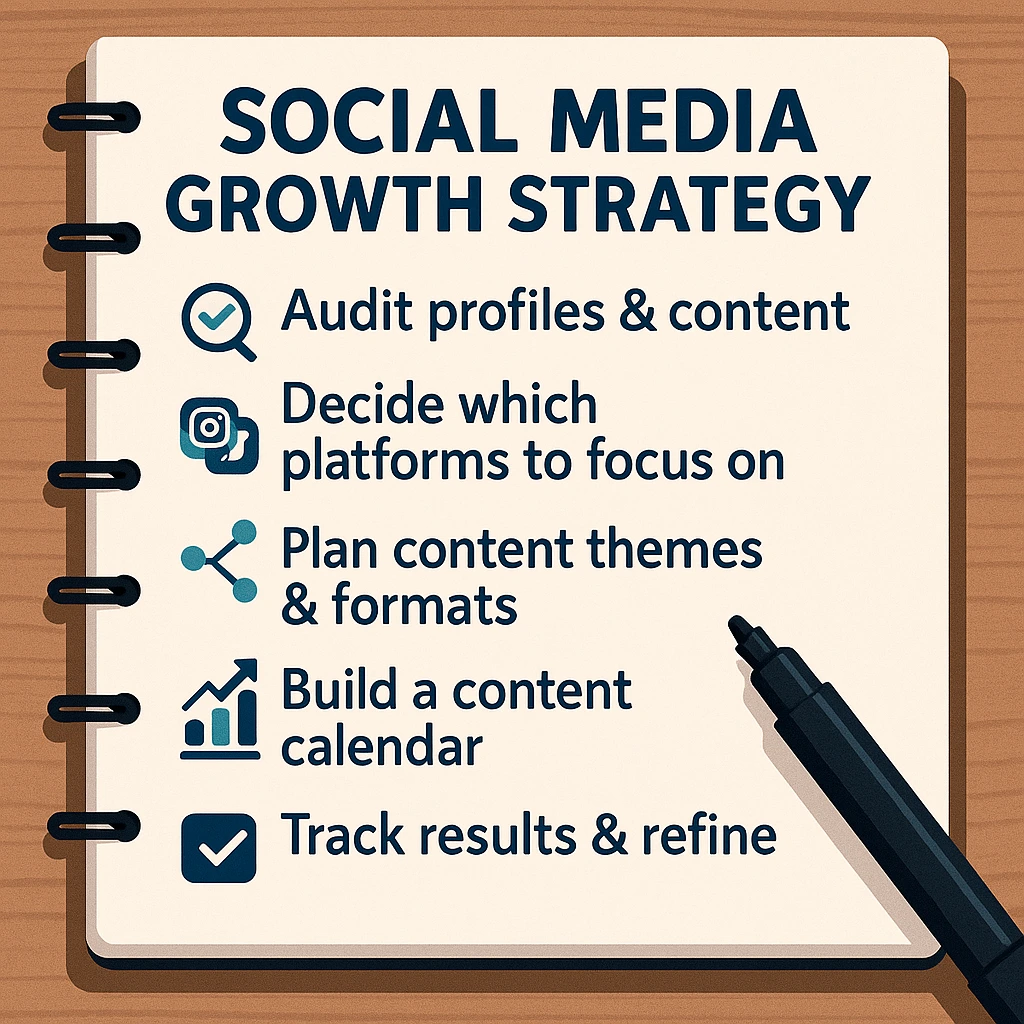
Then they turn findings into strategy. This usually includes:
- which platforms to double down on (and which to drop),
- what content themes to run,
- how often to publish,
- what formats fit your audience right now (short video, carousels, lives, etc.),
- and how social supports your funnel, not just your feed.
After that, they build systems. Content calendars, workflows, brand voice notes, simple templates your team can reuse. This is usually the part where people hesitate… because it feels “too structured.” But structure is what frees you from guessing.
A lot of consultants also coach your team. They’ll review drafts, run workshops, or jump into weekly check-ins. If you’re solo, they act like a sharp second brain.
Finally, they track and refine. Social changes fast in 2025, so consultants watch what’s working, test new ideas, and adjust your approach based on data like engagement rate, CTR, leads, and conversions — the metrics most teams rely on now to prove ROI.
The 7 Clear Signs You Need a Social Media Marketing Consultant
If any of these feel a little too familiar, it’s probably time. Not forever. Not for “because everyone else has one.” But because you’re stuck in a way a specialist can unlock.
Here are seven real-world signals:
- You can’t stay consistent.
Posting in bursts, then disappearing for weeks? That’s one of the most common triggers for hiring outside help in 2025. Consistency is still a major driver of reach and learning. - Engagement is low or sliding.
Not just likes. I mean saves, comments, shares, clicks. When those drop, it usually means your content isn’t matching what the algorithm (or people) wants anymore. - You don’t have a clear strategy.
If your plan is basically “post a few things and hope,” a consultant brings structure fast. Every top 2025 hiring guide flags this as a core reason teams outsource senior thinking. - You can’t prove ROI.
If social feels like a black hole, that’s fixable. Metrics like CTR, conversions, and lead rate are standard now, and a consultant helps wire that up. - Your competitors are pulling ahead.
When your space is moving and you’re not, it’s rarely talent — it’s direction. - You’re struggling with paid social.
Even light ad testing can change growth, but many teams don’t know where to start or how to optimize. - Scaling feels messy.
More platforms, more formats (hello Reels/Shorts/TikTok), more pressure. A consultant turns chaos into a repeatable system. Short-form video and UGC are still dominating attention in 2025, and that shift alone has pushed many brands to hire guidance.
What Results a Social Media Marketing Consultant Should Deliver (Realistic KPIs, Not Vanity Numbers)
You should expect clarity first, then momentum. Not instant virality. Not a follower jackpot.
A solid consultant’s early wins usually look boring on the surface. But they matter. Think: fixing tracking, tightening your positioning, cleaning up profile funnels, and killing off content that’s quietly dragging results down. Most consultants start with an audit → strategy reset → testing plan, because that’s what reliably produces measurable lift in 2025.
After that, you should see improvement in business-tied KPIs, not just “nice numbers.” The big three most brands prioritize now are:
- Engagement rate (quality) — saves, shares, meaningful comments. This is still a top KPI in 2025 because it signals relevance to algorithms and humans.
- Click-through rate (CTR) — how often people take a step off-platform. If your content is doing its job, CTR climbs even before follower growth does.
- Conversions / lead rate — signups, bookings, purchases from social traffic. This is where social proves ROI, and it’s a standard KPI set in most 2025 frameworks.
Follower growth can still happen. Sure. But a consultant will treat it like a lagging indicator, not the goal.
So if someone promises “10k followers in 30 days,” that’s not confidence. That’s marketing.
How to Choose the Right Social Media Marketing Consultant for Your Situation
The “right” social media marketing consultant is the one whose strengths match your exact mess right now. Because a B2B SaaS brand trying to drive demos needs a totally different brain than a local salon trying to fill chairs, or a creator stuck at 8k followers.
Here’s how to sort that out fast:
1. Pick for your goal, not your platform crush.
If your goal is leads or sales, you want someone fluent in funnel thinking and conversion tracking. If your goal is awareness, you want a storyteller who knows how to build reach without burning trust. Social hiring guides in 2025 keep pushing this: align role to outcome first.
2. Look for real niche proof.
Not “I’ve worked with everyone.” That usually means no depth. Ask for examples in your industry or business model. Even one strong, relevant case study beats ten random logos.
3. Decide specialist vs. generalist.
- Specialist = deep on one platform or format (say TikTok growth or LinkedIn thought leadership). Great when you know the bottleneck.
- Generalist = broad strategy across channels. Better when the whole system is foggy. Hiring guides in 2025 frame this as “bottleneck-first hiring.”
4. Check if they’re AI-literate.
This matters now. Consultants don’t need to be AI fanatics, but they should show how they use tools to speed research, test ideas, or improve workflows. Employers are explicitly prioritizing AI-literate marketers in 2025.
5. Make sure their process is clear.
If they can’t explain how they work in plain language, that’s a problem. Strategy should feel structured, not mysterious.
If you end up realizing you need a full-service team instead of a consultant, you can compare some of the best social media marketing companies to see which ones handle both strategy and execution.
Questions to Ask a Social Media Marketing Consultant Before You Hire (Use This Interview Script)
Here are the questions worth asking — pulled from what top hiring guides and 2025 interview frameworks emphasize, but phrased for real humans, not HR robots.
- “What platforms would you prioritize for us, and why?”
You’re looking for audience-and-goal logic, not “TikTok is hot right now.” Good consultants justify choices with fit. - “How do you build a strategy from scratch?”
They should mention research, goals, content planning, and testing loops. If it’s vague, that’s a tell. - “What KPIs would you track for our goals?”
In 2025, serious social work ties to metrics like engagement quality, CTR, leads, or sales — not just follower growth. - “Show me a recent win — and a recent failure.”
Honestly, this part trips people up. If they can’t talk about what didn’t work and what they changed, they probably don’t test much. - “What does your weekly/monthly process look like?”
You want to hear about calendars, approvals, reporting cadence, and collaboration. Process clarity is a big selection factor in current guides. - “How do you use AI (if at all) in your workflow?”
AI is a normal part of marketing in 2025, especially for analysis and iteration — but it shouldn’t replace strategy or voice.
If their answers feel tailored, grounded, and a little nerdy? That’s a good sign.
Red Flags to Watch For When Hiring a Social Media Marketing Consultant
If you remember one thing from this guide, make it this: anyone who guarantees outcomes on social is selling fantasy, not skill. Platforms change weekly, audiences are messy, and no consultant controls your market. So “I guarantee 10k followers in a month” or “we’ll go viral fast” is a hard no. Multiple 2024–2025 hiring guides call guaranteed results and vague promises the biggest warning signs.
Next red flag: they can’t show clear, relevant proof. Not screenshots of likes. Not a logo wall. You want case studies tied to outcomes — growth in qualified leads, engagement quality, CTR, sales, whatever matches your goals. If they dodge specifics or talk only in vibes, move on.
Watch for strategy fog. If they can’t explain their process simply — audit → plan → test → report — you’re about to pay for chaos. Good consultants are structured and transparent about how they work.
Also, look out for pricing weirdness. Hidden fees, unclear scope, or “we’ll figure it out later” always turns into surprise invoices and frustration. Modern guides are blunt about this: clarity upfront protects both sides.
And finally, platform hype over business goals. If they push TikTok/IG/LinkedIn just because it’s trendy — without tying it to your audience and funnel — they’re not consulting. They’re projecting.
If you feel pressured, confused, or dazzled instead of confident? Trust that signal.
Social Media Marketing Consultant Pricing — What You’ll Pay and Why
Most people want a clean number here. I get it. But pricing depends on scope + seniority + how messy your situation is. Still, 2025 data gives solid guardrails.
For hourly work, social media consultants typically sit around $50–$150/hour for mid-to-senior folks, with very experienced specialists often charging $150–$250/hour. Entry-level or junior consultants can be lower, but you’re usually paying for execution help, not high-level strategy.
For project-based strategy (like an audit + 90-day plan), expect roughly $1,000–$10,000+, depending on how deep they go and how many channels/offers are involved.
For monthly retainers, which are common when you want ongoing guidance, ranges usually land in these buckets:
- Light advisory / coaching: about $1,000–$3,000 per month
- Strategy + ongoing optimization: about $2,000–$8,000 per month
- High-level fractional leadership: can climb well past that, especially if they’re acting like a mini-CMO.
Why the spread? A few things drive cost fast:
- number of platforms
- content complexity (short-form video costs more to steer well)
- whether they touch paid social
- your industry (regulated niches usually cost more)
- how much they need to rebuild vs. tweak.
And if you want a clearer sense of what real-world scopes look like, you can compare different social media growth packages to see how pricing shifts with deliverables.
FAQs About Hiring a Social Media Marketing Consultant
It depends on time, skill, and stakes. A lot of small business owners on Reddit say social only works when someone can give it consistent, strategic effort — if you don’t have that, hiring help can absolutely be worth it
How long before I see results after hiring a consultant?
Do I have to give my consultant my passwords? Is that even safe?
In 2025, you rarely need to hand over raw passwords. For Meta platforms (Facebook, Instagram), you can grant access via Meta Business Suite/Portfolio or page roles; for Google Business, you can add them as a manager; for tools like Buffer, Hootsuite, or Later, you invite them into the workspace instead.
Does my consultant need a huge following themselves to be any good?
Not really. A big personal following can help them market their services, but it’s not a reliable measure of whether they can grow your audience in your niche.