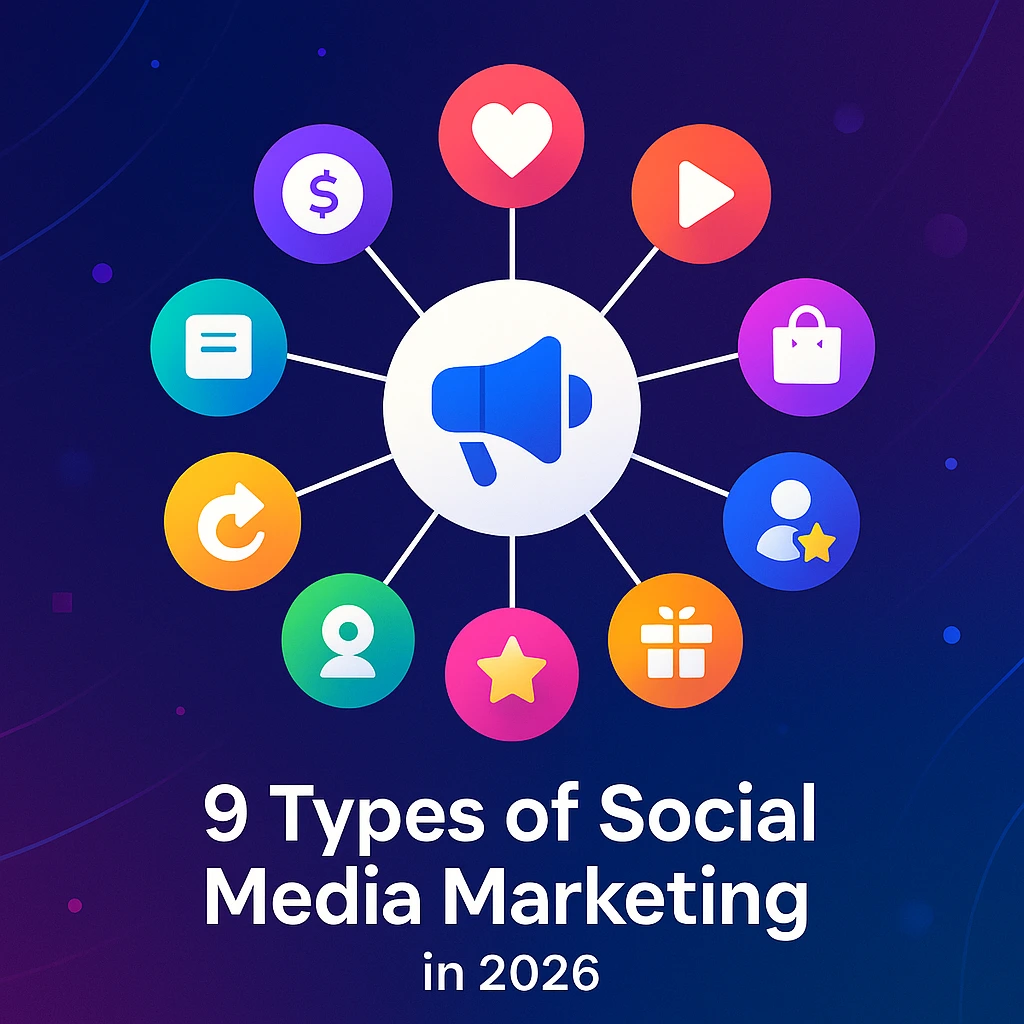
Social media marketing isn’t just “posting more often” anymore. In 2026, you’ve got multiple moving parts—organic content, creators, ads, communities—all fighting for the same attention.
This guide breaks down 9 key types of social media marketing, when to use each one, and how to combine them into a strategy that actually moves revenue, not just vanity metrics.
The 9 Main Types of Social Media Marketing in 2026 (Quick Overview)
Before we dive into tactics, here’s the fast version. These are the nine types you’ll see over and over again in brands that are actually winning on social right now.
| # | Type of social media marketing | What it is (in plain English) | Best for in 2026 |
|---|---|---|---|
| 1 | Organic social & content marketing | Your regular posts, stories, carousels, and short videos that show up without paying for ads. | Building trust, staying visible, nurturing an audience over time. |
| 2 | Paid social media advertising | In-feed ads, sponsored posts, and boosted content you pay platforms to show to targeted people. | Fast reach, testing offers, scaling what already works. |
| 3 | Retargeting & remarketing campaigns | Ads that “follow” people who visited your site or engaged with you but didn’t convert. | Recovering abandoned carts, nudging “almost buyers,” improving ROAS. |
| 4 | Influencer & creator marketing | Partnering with creators—especially nano/micro influencers with higher engagement—to promote your brand. | Borrowing trust, entering new niches, launching products. |
| 5 | User-generated content (UGC) campaigns | Getting real customers to create content (reviews, unboxings, testimonials) and reusing it in your marketing. | Social proof, ad creatives that feel native, higher conversion rates. |
| 6 | Video & live streaming marketing | Short-form videos (Reels, TikToks, Shorts) and live sessions focused on education, demos, or entertainment. | Capturing attention, explaining products quickly, boosting engagement. |
| 7 | Social commerce & shoppable experiences | In-app shops and shoppable posts (e.g., TikTok Shop, Instagram Shopping) where people can buy without leaving. | Turning views into sales, especially for DTC and product brands. |
| 8 | Contests, giveaways & gamified campaigns | Time-limited promos that ask people to follow, comment, tag, or create content in exchange for a prize. | Rapid audience growth, email list building, UGC generation. |
| 9 | Community-building & social customer care | Groups, private communities, DMs, and comments where you actually talk to people and support them. | Retention, loyalty, referrals, and turning customers into advocates. |
How to Choose the Right Types of Social Media Marketing for Your Business
If you want the short answer, it’s this: your mix of social media types should follow your goal, your business stage, and your resources—in that order. Most brands get into trouble because they start with tactics (“we should be on TikTok”) instead of outcomes (“we need 50 new customers a month”).
Start with one primary business goal
For the next 90 days, pick a single main goal: brand awareness, leads, direct sales, or customer retention. Each of these naturally leans toward different types of social media marketing. Awareness usually pairs best with organic content, video, and creator collaborations, because those formats reach people who don’t know you yet. If leads are the priority, paid social, retargeting, and the occasional giveaway or gamified campaign tend to pull more people into your email list or CRM. When you care mostly about sales, paid ads, retargeting, social commerce, and UGC-style creatives usually do the heavy lifting. And if your main challenge is keeping customers around, community-building, a solid social media growth strategy, social customer care, and consistent organic content become more valuable than chasing reach.
Match the types to your business stage
Rough guide:
Established brands:
Can justify influencer programs, communities, always-on paid, and more sophisticated retargeting.
New / early-stage brands:
Focus on organic + video to find your voice, then layer small paid tests and UGC as soon as you have happy customers.
Growing SMBs / DTC brands:
Usually win with a stack like: organic + video + paid ads + retargeting + social commerce. Short-form video and social commerce are especially important now, as TikTok, Instagram, and others keep pushing in-app shopping harder going into 2026.
Be honest about your resources
This is the part people usually skip. Your ideal strategy on paper might include five or six types of social media marketing, but if you’re short on time, budget, or team, that’s a fast track to burnout and inconsistent posting. If you have time but little money, it makes more sense to focus on organic content, live or informal video, and basic community-building, where your main investment is effort rather than ad spend. If you have more budget than time, you’ll likely get better results by prioritizing paid campaigns, retargeting, and UGC-based creatives, while outsourcing parts of the content production or account management. And if you’re short on both for now, the smartest move is to start small: pick one platform, one core content format, and one clear offer, then commit to showing up consistently. From there, you can layer in additional types once you’ve proven that your basics actually convert.

Type 1 – Organic Social & Content Marketing (A Core Type of Social Media Marketing)
If there’s one type of social media marketing every brand needs in 2026, it’s this one. Organic social is all the content you publish without putting ad spend behind it—your posts, stories, carousels, short videos, replies, and DMs. It’s how people get to know you when they’re not being “sold to,” which is exactly why it still matters even as algorithms get harsher. Recent guides and industry reports are very consistent on this: organic social is what builds authentic connections, trust, and long-term loyalty, while paid is better at short-term spikes.
Of course, organic reach isn’t what it used to be. Studies comparing 2020 to 2023 show average organic reach dropping by around 60%, which is why most 2025 playbooks talk about hybrid strategies—organic for relationship-building, paid for amplification. That doesn’t mean “organic is dead.” It means your unpaid content now has a different job: it keeps your brand visible to existing followers, shows your personality, and proves you’re real. In a world where more than 5.2 billion people are active on social media in 2025, that consistent presence is often the difference between being remembered and being ignored.
Type 2 – Paid Social Media Advertising (One of the Most Scalable Types of Social Media Marketing)
Paid social is how you buy smart, targeted visibility instead of waiting for the algorithm to be kind.
Paid social covers any content you pay platforms to show—feed ads, Stories, Reels ads, TikTok in-feed, LinkedIn Sponsored Content, all of it. Global ad spend is projected to hit around $1–1.17 trillion in 2025, with digital (and especially social) driving most of that growth, which tells you brands still see this as a profitable channel.
Why paid social still matters in 2026 (based on 2025 data):
- Digital ad spend is growing faster than traditional, with most forecasts putting digital at ~70–75% of total ad spend in 2025.
- Social platforms like Facebook, Instagram, YouTube and TikTok remain among the top ROI channels in marketer surveys.
- Precision targeting (interests, behaviors, job titles, lookalikes) is still a key draw, with a rising share of spend going to algorithm-driven campaigns.
This is usually the part where people freeze and think, “I don’t want to waste money on ads.” And that’s fair. Paid social will waste budget if your offer, creative, or landing page is weak. Ads don’t fix a broken funnel; they just reveal it faster.
Type 3 – Retargeting & Remarketing Campaigns as a High-ROI Type of Social Media Marketing
Retargeting is the type that quietly saves a lot of money. Instead of advertising to strangers, you show ads to people who already visited your site, viewed a product, added to cart, or engaged with your content but didn’t convert.
The data in 2024–2025 is pretty clear: retargeting consistently outperforms cold traffic. Analyses show retargeting can boost conversion rates by 40–150%, generate click-through rates up to 10x higher than standard display ads, and is seen by the vast majority of marketers as more effective than non-retargeted campaigns. In plain English: people who already know you are simply more likely to buy.

Type 4 – Influencer & Creator Marketing: A Trust-Driven Type of Social Media Marketing
Influencer and creator marketing is no longer a “nice extra.” By 2025, it’s a $30+ billion industry, expected to reach about $32.5 billion by the end of the year, and it keeps growing faster than many traditional ad channels. In plain terms: brands are shifting serious budget into creators because audiences actually listen to them.
One important shift in the last few years is who brands prefer to work with. Instead of chasing only mega-celebrities, most marketers now lean heavily toward micro and mid-tier creators. Recent reports show that around 73% of brands prefer micro and mid-tier influencers, because they deliver the best mix of engagement and cost. Multiple studies back this up: micro and nano influencers regularly show higher engagement rates and stronger conversion impact than macro accounts, especially in niche markets. Bigger isn’t always better; “just big enough and still human” is where the ROI usually lives.
For you, influencer marketing in 2026 is less about one-off #ad posts and more about integrated collaborations. That might look like a creator making a series of TikToks and Reels, letting you repurpose their content into Spark Ads or Partnership Ads, appearing in a live shopping stream, or co-creating a product drop. Brands increasingly plan to reuse creator content across paid campaigns and social commerce, not just rely on organic reach.
The tricky part is fit. The creators who perform best for brands in 2025 reports aren’t just those with big numbers, but those whose audience, values, and content style line up with the brand’s positioning—and who feel authentic, not overly scripted. If you treat influencer marketing as “renting trust from the right people,” and you’re picky about that fit, it becomes one of the most powerful types of social media marketing you can add to your mix.
Type 5 – User-Generated Content (UGC): A Social Media Marketing Type Built on Social Proof
Think of UGC as content you didn’t have to create yourself—photos, videos, reviews, unboxings, before-and-afters, stories, all made by real customers. In 2026, this isn’t just “nice to have.” It’s one of the strongest trust signals you can show on social.
Why UGC is so powerful (based on 2023–2025 data)
Recent studies are all pointing in the same direction:
- Surveys show around 84% of people are more likely to trust a brand that uses UGC in its marketing.
- Shoppers heavily rely on peer content: one 2023 study found 88% of shoppers consult ratings and reviews before buying, and just 10 reviews can lift conversion rate by about 45%.
- More recent reports in 2024–2025 suggest over 90% of people trust reviews and user posts more than ads, and Instagram posts featuring user content get significantly more engagement than pure brand posts.
- Brands that put UGC into ads see big performance lifts: some studies show UGC-based ads getting up to 4x higher click-through rates and around 29% higher conversion rates than non-UGC ads.
So when marketers say “UGC converts,” they’re not guessing. The numbers back it up.
You don’t need a giant brand to tap into this. A few practical plays:
- Turn reviews into content
Take real quotes from reviews or emails, drop them into simple graphics, and post them as carousels or stories. Add a quick caption about the customer’s context so it feels human, not staged. - Reshare real customer photos and videos
Encourage people to tag you or use a branded hashtag. With permission, repost their content to your feed, stories, or Reels/TikToks. This is especially effective for fashion, beauty, fitness, food, and lifestyle brands. - Feed your ads with UGC
Take your best-performing UGC posts and test them as ad creatives. The data suggests these “real-feeling” assets usually beat slick studio shoots for click-throughs and conversions. - Tie UGC into social commerce
Place customer photos and short clips next to shoppable posts or in-app product pages (TikTok Shop, Instagram Shopping, etc.). Seeing real people using the product inside the platform can push someone from “maybe” to “okay, I’m in.”
A simple UGC campaign structure
If you want something you can run in the next 30 days, keep it basic:
- Pick one product or offer you want to push.
- Create a clear ask: “Share a photo or 10-second video using [product], tag us, and use #[YourHashtag].”
- Offer a small incentive: monthly giveaway, feature on your page, early access, or a discount code for participants.
- Collect, organize, and get permissions for reuse.
- Turn the best pieces into posts and ad creatives, then watch which ones move clicks, saves, and sales.
Honestly, the hardest part isn’t getting people to talk about you—it’s remembering to ask, and then actually using what they share. Once you treat your customers as a mini media team, UGC becomes one of the most efficient types of social media marketing you have.
Type 6 – Video & Live Streaming as Fast-Growing Types of Social Media Marketing in 2026
If there’s one format you can’t ignore in 2026, it’s video. Short-form clips and live streams dominate attention across TikTok, Instagram Reels, YouTube Shorts, and more—and the data from 2023–2025 makes that painfully clear.
What the numbers say about video
A few key trends keep repeating across industry reports:
- Marketers consistently rank short-form video as the #1 content format for ROI, ahead of images and long-form posts.
- Global online video consumption has climbed to ~17 hours per week per user on average, with a big chunk of that on social platforms.
- TikTok, Instagram Reels, and YouTube Shorts are still growing in watch time and ad revenue as of 2024–2025, which is why platforms keep pushing these formats in the feed.
So when people say, “Video is where your audience actually hangs out,” they’re not guessing. They’re just reading the same charts.
You don’t need viral dances. You need clear, simple clips that match where someone is in the buying journey:
- Top of funnel: quick tips, myths, “here’s what most people get wrong” content.
- Middle of funnel: product demos, comparisons, mini case studies, FAQs.
- Bottom of funnel: testimonials, before/after stories, “what I’d choose if I were you.”
Most brands do well starting with 15–30 second clips, shot on a phone, with clear hooks in the first 2–3 seconds and captions for silent viewers.
Where live streaming fits in
Live streaming hasn’t replaced everything else, but it’s become a strong conversion and engagement layer, especially with:
- Live shopping / live commerce (huge in Asia, growing steadily in Western markets via TikTok Shop, Instagram, and YouTube).
- Launch events, Q&As, and behind-the-scenes sessions that build trust and urgency in real time.
Even a simple monthly live “office hours” or product walkthrough can deepen relationships far more than another static post.
The bottom line: in 2026, video and live aren’t “advanced” tactics. They’re becoming the default way people experience brands on social, and every other type of social media marketing—UGC, influencers, social commerce, even customer care—plugs into this format sooner or later.
Type 7 – Social Commerce & Shoppable Posts: A Direct-Sales Type of Social Media Marketing
Social commerce is where “scrolling” quietly turns into “shopping”. Instead of sending people off to a website, you sell inside platforms like TikTok, Instagram, Facebook, and Pinterest through in-app shops, product tags, and shoppable videos.
Over the last few years, the numbers have gone from “interesting” to “hard to ignore”:
- Global social commerce sales were estimated in the hundreds of billions of dollars by the mid-2020s, with forecasts pointing to continued strong growth through 2025 and beyond as more platforms roll out native shopping tools.
- TikTok has aggressively expanded TikTok Shop in the US, UK, and other markets, blending short-form video, live shopping, and in-app checkout into one experience.
- Meta continues to push Instagram Shopping and Facebook Shops, letting brands tag products in posts, Reels, and stories so users can move from discovery to purchase with fewer clicks.
The theme is pretty simple: platforms make more money when people buy without leaving, so they’re heavily incentivized to keep improving these features.
For most brands, social commerce in 2026 will revolve around a few core moves:
- Product tagging in content
Tag products directly in posts, Reels, TikToks, and stories so someone can tap once to see the item and again to buy. This turns “that looks nice” into an actual product page, without bouncing them out to a browser. - In-app shops and catalogs
Set up a TikTok Shop, Instagram Shop, or Facebook Shop so your catalog lives natively on the platform. That way, when creators or your own posts tag products, there’s a smooth path to checkout. - Shoppable live streams and lives with links
Run live demos, try-ons, tutorials, or Q&As and pin product links while you talk. This format is already massive in China and has been steadily growing in Western markets as TikTok, Instagram, and YouTube all lean into live shopping. - Creator-led social commerce
Combine influencer/creator marketing with social commerce by giving creators affiliate links or the ability to tag your products directly. Their content can then feed into your in-app shop, live events, and paid campaigns.
Social commerce isn’t ideal for every single business model (no one’s buying a complex B2B software license fully inside Instagram… yet), but it’s extremely powerful for:
- DTC and ecommerce brands with visual products (beauty, fashion, home, accessories, gadgets).
- Brands already seeing strong engagement on short-form video or creator content.
- Offers that don’t require a long decision cycle—impulse buys, gifts, lower-ticket items, and simple subscriptions.
The big mindset shift is this: instead of treating social as “just marketing” and your website as “where selling happens,” social commerce turns your social presence into a direct storefront, sitting right where your customers already spend their time.
Type 8 – Contests, Giveaways & Gamified Campaigns as Engagement-Driven Types of Social Media Marketing
Contests and giveaways are the “fast growth” lever of social media marketing. When they’re done well, they spike engagement, followers, and email leads far more quickly than regular posts.
What contests actually do (backed by 2025 data)
Recent stats show they’re not just hype:
- Instagram contests receive about 3.5x more likes and 64x more comments than regular posts.
- Accounts that run contests grow about 70% faster than those that don’t, yet only 2% of Instagram marketers actually use them—meaning there’s still a big opportunity.
- A 2025 roundup of giveaway statistics highlights that contests are widely used to boost engagement, generate leads, and build brand loyalty, especially when tied to email signups or UGC.
- Guides from platforms like Sprinklr in 2025 keep positioning contests as a low-cost, high-impact tactic for reach, content generation, and interaction.
In a world where average engagement rates are dropping across major platforms, anything that multiplies comments and shares is worth a serious look.
The upside (and the main risks)
Done well, contests can:
- Inject a burst of visibility and engagement into an account that’s gone a bit quiet.
- Generate UGC at scale (photos, videos, stories you can later reuse). Opinion Stage
- Grow your email list or follower base quickly when entry rules include following, tagging, or opting in.
Done badly, they can:
- Attract “freebie hunters” who never buy or engage again.
- Inflate follower numbers while hurting long-term engagement rate, because many new followers don’t actually care about your content.
- Cause issues with platform rules or local laws if terms and conditions aren’t clear.
That’s why “gamified” doesn’t mean “anything goes.” You still need guardrails.
A simple structure for high-quality contests
To keep contests strategic (not just noisy), anchor them to a clear outcome:
- Start with one main goal
Example: “Add 1,000 qualified email subscribers,” or “Collect 50 pieces of usable UGC,” rather than “get more followers.” - Choose a prize that filters for the right people
A brand-relevant prize (your own product, bundle, session, or credit) works better than generic tech or cash, because it attracts people who actually want what you sell. - Make the entry actions match the goal
- Want leads? Require email signup.
- Want UGC? Ask for a photo, video, or story using a branded hashtag.
- Want reach? Include tagging or sharing as secondary actions, not the only thing.
- Follow up after the contest ends
Thank participants, send a small perk to non-winners (e.g., discount or bonus content), and repurpose the best entries into posts and ads. A lot of brands leave money on the table by stopping right after announcing the winner.
Used this way, contests and giveaways become less of a gimmick and more of a repeatable growth mechanic you can plug into your social strategy a few times a year—especially when paired with UGC, video, and social commerce.
Type 9 – Community-Building & Social Customer Care: A Relationship-Focused Type of Social Media Marketing
Community-building and social customer care are the “quiet compound interest” of social media marketing. They don’t always go viral, but they’re often the reason customers stick around, spend more, and refer friends.
Why community and support matter so much now
The data from the last few years points in one direction: people buy from brands that feel close and responsive.
- Research shows that customers are significantly more loyal to brands that respond quickly on social; many expect a response within hours, not days.
- Studies on online communities and loyalty consistently find that engaged communities increase repeat purchase intent and referral likelihood, especially in verticals like gaming, beauty, fitness, and SaaS.
- Customer experience reports from 2023–2025 show social channels becoming one of the primary support touchpoints, not just a marketing add-on. People now treat DMs and comments like a helpdesk.
So while community-building and social care don’t always show up in “top of funnel” charts, they show up in lifetime value, retention, and word of mouth.
What community-building looks like in 2026
You don’t need a huge Discord server or fancy membership program to say you have a community. Common, realistic forms include:
- Platform-native groups and spaces
Facebook Groups, LinkedIn communities, subreddits, and even close-friends lists or broadcast channels on Instagram all act as semi-private spaces where your most engaged people gather. - Active comments and DMs
Replying to comments, answering questions, and following up in DMs. It sounds basic, but many brands still treat social like a one-way broadcast, which is exactly where you can stand out. - Recurring “rituals”
Weekly Q&As, check-in posts, challenges, or live sessions—anything that gives people a reason to come back regularly and interact with each other, not just with you.
In 2026 community trend reports, brands that invest in these ongoing interactions tend to report higher engagement rates and stronger brand affinity compared to those that only post polished content.
Social customer care as part of your marketing
Customer service on social used to be purely reactive: a complaint pops up, someone scrambles to fix it. In 2026, the smarter approach is to treat social care as part of your marketing:
- Respond visibly and helpfully
When you handle questions and complaints in the open, you’re not just solving one person’s problem; you’re showing everyone else you’re trustworthy. - Create content from repeat questions
If you keep seeing the same concerns in DMs and comments, turn them into posts, Reels, or FAQ threads. This reduces support volume and makes your content more relevant at the same time. - Track response time and satisfaction
Many social tools now surface response-time metrics and sentiment. Brands that keep response times low and tone respectful tend to win more long-term loyalty.
It’s easy to obsess over reach and impressions, but community-building and social care are where a lot of the real money is protected and you need to understand what typical pricing for growth services looks like. Followers come and go; community members and well-treated customers often stay, spend more, and bring others with them.
Key Takeaways: The 9 Types of Social Media Marketing in 2026
- You don’t need all 9 types. Most brands win with a focused stack of 3–5 (e.g., organic + video + UGC + paid + retargeting).
- Short-form video still leads in ROI. TikTok, Reels, and Shorts drive discovery and conversions more effectively than static content.
- UGC & creators outperform polished brand content. People trust real customers and relatable creators far more than traditional ads.
- Paid + retargeting = efficiency. Retargeting warm audiences remains one of the highest-ROI social media tactics available.
- Social commerce is exploding. TikTok Shop, Instagram Shopping, and live shopping can reduce friction and increase sales dramatically.
- Contests work—but only with the right prize. Brand-relevant rewards attract qualified followers instead of freebie hunters.
- Communities and social customer care build lifetime value. Fast responses, helpful support, and recurring interactions keep customers loyal.
- Consistency beats intensity. Sustainable posting (not daily burnout) is what grows reach, trust, and eventually revenue.
- Your offer matters more than your tactics. Weak messaging or unclear value can’t be fixed by any type of social media marketing.
FAQs: Types of Social Media Marketing in 2026
Here are some repetitive questions gathered by Social Media Tutor team regarding types of social media marketing:
Why do some people say “organic vs paid” are the only two types?
Can I grow only with organic (no ads)?
What’s actually working best for marketers right now, according to Reddit and forums?
Further Reading
- HubSpot – Social Media Marketing Guide
- Sprout Social – Types of Social Media Content & Strategy Insights